Forbidden City
Dublin Core
Title
Forbidden City
Subject
Immovable Culture Heritage
Description
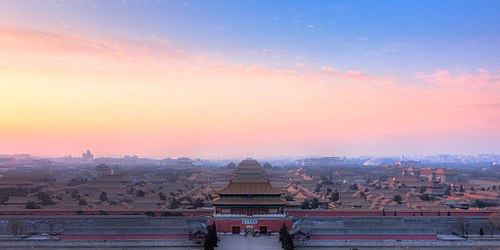
The Forbidden City (Chinese: 紫禁城; pinyin: Zǐjìnchéng) is a palace complex in Dongcheng District, Beijing, China, at the center of the Imperial City of Beijing. It is surrounded by numerous opulent imperial gardens and temples including the 22 ha (54-acre) Zhongshan Park, the sacrificial Imperial Ancestral Temple, the 69 ha (171-acre) Beihai Park, and the 23 ha (57-acre) Jingshan Park.[2] It is officially administered by the Palace Museum. (Wiki, 2023)
The Forbidden City was constructed from 1406 to 1420, and was the former Chinese imperial palace and winter residence of the Emperor of China from the Ming dynasty (since the Yongle Emperor) to the end of the Qing dynasty, between 1420 and 1924. The Forbidden City served as the home of Chinese emperors and their households and was the ceremonial and political center of the Chinese government for over 500 years. Since 1925, the Forbidden City has been under the charge of the Palace Museum, whose extensive collection of artwork and artifacts were built upon the imperial collections of the Ming and Qing dynasties. The Forbidden City was declared a World Heritage Site in 1987.[3] (Wiki, 2023)
The complex consists of 980 buildings,[4] encompassing 9,999 rooms and covering 720,000 m2 (72 ha)/178 acres.[5][6] The palace exemplifies the opulence of the residences of the Chinese emperor and the traditional Chinese palatial architecture,[3] and has influenced cultural and architectural developments in East Asia and elsewhere. It is listed by UNESCO as the largest collection of preserved ancient wooden structures in the world. Since 2012, the Forbidden City has seen an average of 14 million visitors annually, and received more than 19 million visitors in 2019.[7] In 2018, the Forbidden City's market value was estimated at 70 billion USD, making it both the world's most valuable palace and the most valuable piece of real estate anywhere in the world.[8] (Wiki, 2023)
The Forbidden City in Beijing is one of the largest and most well-preserved wooden structures in the world. It was listed as the first batch of national key cultural relics in 1961. (Wiki, 2023)
Date
1420
Contributor
yz221@st-andrews.ac.uk
Language
Chinese
Type
Site
Identifier
608
Date Submitted
05/04/2023
References
https://en.wikipedia.org/wiki/Forbidden_City
Extent
cm x cm x cm
Medium
https://en.wikipedia.org/wiki/Forbidden_City
Spatial Coverage
current,39.916319613808135,116.39061927795412;
Europeana
Europeana Data Provider
Forbidden City
Object
https://en.dpm.org.cn/
Europeana Type
TEXT
Site Item Type Metadata
Institutional nature
Building
Place
Dongcheng District, Beijing
End Date
now
Status
public
Condition
1
Contact
yz221@st-andrews.ac.uk
Collection
Citation
“Forbidden City,” STAGE, accessed October 16, 2026, https://stage.openvirtualworlds.org/omeka/items/show/1165.
Embed
Copy the code below into your web page