Richat Structure-The Eye of Sahara
Dublin Core
Title
Richat Structure-The Eye of Sahara
Subject
Tourism
Description
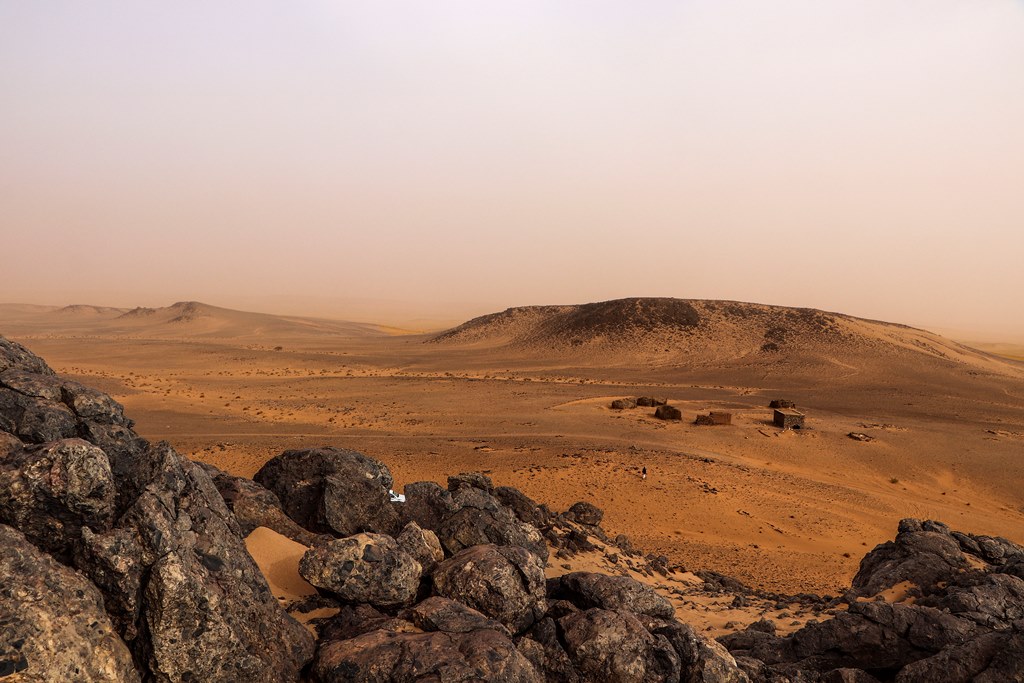
The Eye of the Sahara, also referred to as the Richat Structure, is a geological phenomenon of significant cultural, historical, and scientific value in Mauritania. The structure emerged over millions of years due to the gradual erosion of rock layers and is visible from space. It holds immense importance for archaeology, given its composition of bimodal tholeiitic and alkaline volcanism dating back to the Cretaceous era. Because of its striking circular shape, the structure remains a subject of considerable scientific inquiry. Its study has contributed significantly to our understanding of plate tectonics and the evolution of the Earth's surface.
Source
is51102023
Date
100 million years ago
Contributor
DiMei
Language
English
Type
Site
Identifier
752
Date Submitted
06/05/2023
References
[1] Matton G, Jébrak M. The “eye of Africa”(Richat dome, Mauritania): An isolated Cretaceous alkaline–hydrothermal complex[J]. Journal of African Earth Sciences, 2014, 97: 109-124. [2] Abdeina E H, Bazin S, Chazot G, et al. Geophysical modelling of the deep structure of the Richat magmatic intrusion (northern Mauritania): insights into its kinematics of emplacement[J]. Arabian Journal of Geosciences, 2021, 14: 1-13.
Extent
-cm x -cm x -cm
Medium
https://en.wikipedia.org/wiki/Richat_Structure
Spatial Coverage
current,20.54,11.24;
Provenance
-
Europeana
Europeana Data Provider
Richat Structure-The Eye of Sahara
Object
https://en.wikipedia.org/wiki/Richat_Structure
Europeana Type
TEXT
Site Item Type Metadata
Institutional nature
Place Name
Place
Sahara Desert of Mauritania, West Africa
Prim Media
1628
End Date
Now
Status
public
Stewardship
-
Condition
1
Contact
dm333@st-andrews.ac.uk
Notes
The site holds cultural and spiritual significance for the local Mauritanian population. It is believed to have functioned as a landmark for early traders and travelers because of its visibility from afar in the otherwise barren desert terrain.
In an effort to promote and preserve this valuable heritage, digital technologies such as virtual tours and interactive maps have been utilized. 2D and 3D modeling techniques have also played a crucial role in this regard. Geophysical modeling founded on high-resolution airborne magnetic data and satellite gravimetric data has enabled the imaging of the buried structures of the Richat magmatic complex, the identification of hydrothermal alteration zones, and the elaboration of a kinematic model for its emplacement. The digital use of this heritage has the potential to facilitate a better understanding of how the Earth has evolved over hundreds of millions of years.
Collection
Citation
“Richat Structure-The Eye of Sahara,” STAGE, accessed October 17, 2026, https://stage.openvirtualworlds.org/omeka/items/show/1629.
Embed
Copy the code below into your web page