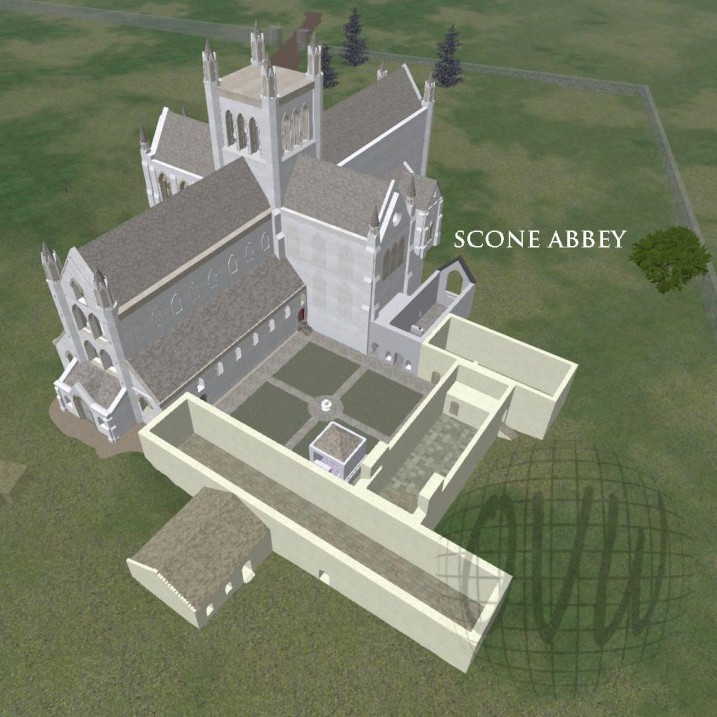
The Augustinian Abbey of Scone – 1390
Dublin Core
Title
The Augustinian Abbey of Scone – 1390
Subject
Intangible Heritage
Description
Scone Abbey, a historic Augustinian abbey in Scotland, was founded in the 12th century and elevated to an abbey in 1169. The abbey was destroyed by a mob from Dundee during the Reformation in 1559. The site of the Abbey now lies under the front lawn of Scone Palace, but one thing remains: Moot Hill, where Scottish Kings were crowned on the Stone of Destiny.
The precise location of Scone Abbey had long remained a mystery, but in July 2007, archaeologists pinpointed the location using Ground Penetrating Radar (GPR) technology. Scone Abbey’s structure was revealed to be larger than had once been imagined, and the exact location was pinpointed.
Source
reconstructions
Date
2014
Format
image/jpeg
Type
Reconstruction
Identifier
203
License
In Copyright (InC)
Spatial Coverage
current,56.4225,-3.438056;
Europeana
Is Shown At
https://www.openvirtualworlds.org/scone-abbey/
Object
https://openvirtualworlds.viewin360.co/share/collection/7Jl27?logo=0&info=0&fs=1&vr=1&sd=1&initload=0&thumbs=1
Europeana Rights
Open Virtual Worlds Team University of St Andrews
Europeana Type
TEXT
Reconstruction Item Type Metadata
Canmore
https://canmore.org.uk/site/28190/scone-palace
How
In 2007, Dr O’Grady conducted archaeological research on the site of Scone, which revealed most of the surviving ground plan of the medieval abbey church and also the original form of the Moot Hill royal assembly mound and its enclosures. He explains, “This project is a great opportunity to cut through all the myths surrounding Scone and create a new informed account of Scone’s place in our national story and international heritage sites.”
This reconstruction is part of the larger project entitled ‘Royal Scone: parliament, inauguration and national symbol’. Professor Richard Oram, project leader and Professor of Environmental and Medieval History at the University of Stirling, said: “Despite Scone’s importance in Scottish identity and Scotland’s history, there is currently limited understanding of the site, the function of its components, and the nature of the activities undertaken there. This project will assemble a network of researchers in archaeology, architectural history, legal and political history – including representatives from Historic Scotland – to develop a wider and more accurate picture of what royal Scone was like.”
Evidence
In 2014, we collaborated with archaeologist Oliver O’Grady, manager and director of Perthshire-based OJT Heritage, working with the archaeological data he had gathered.
We consulted with Medieval Scottish Architecture experts Prof Richard Fawcett and Prof Richard Oram.
We created a 3D virtual model to help us better understand the Scone Abbey site. Dr Oliver O’Grady of the MASS Project (Moothill and Abbey Survey Scone) said:
“There had been speculation that the mound was created by nobles travelling to Scone for the coronation of Robert the Bruce or that it could have been some kind of geological phenomenon but our dig shows that it was man-made and created at the very beginning of the Kingdom of Scotland.
“It doesn’t take away from the myths or the stories, which I think archaeologists and people in general have always taken with a pinch of salt, but what it does is it gives us our first firm foothold of the history of Moothill.”
He added: “Scientific studies on the artefacts and samples recovered during excavations in 2008 and 2009 have been ongoing since last year. This has thrown up fascinating revelations about Scone’s history but the new dates from the Moothill are by far the most significant discovery to date.
“The radiocarbon dates confirm Scone’s Moothill as one of Europe’s extraordinary survivals, unique in Britain and the first assembly-mound in Scotland to be scientifically dated. The lab results are in a sense nothing less than a birth certificate for Scotland.”
Advisers
Oliver O'Grady (OJT Heritage) Prof Richard Fawcett (University of St Andrews) Prof Richard Oram (University of Stirling)
Date Represented
1390
Collection
Citation
“The Augustinian Abbey of Scone – 1390,” STAGE, accessed October 17, 2026, https://stage.openvirtualworlds.org/omeka/items/show/188.
Embed
Copy the code below into your web page