Callanish Stone Circle
Dublin Core
Title
Callanish Stone Circle
Description
Callanish X (also known as "Na Dromannan" and "Druim Nan Eun") Callanish (or "Calanais") Stone Circle.
The Isle of Lewis has an extraordinarily rich prehistoric landscape, with monuments dating back more than 5,000 years to the Neolithic period. The area around Callanish appears to have been a particularly important Neolithic ritual centre, with a concentration of impressive standing stones. The most famous of these is a cross-shaped arrangement of stones now known as Callanish I.
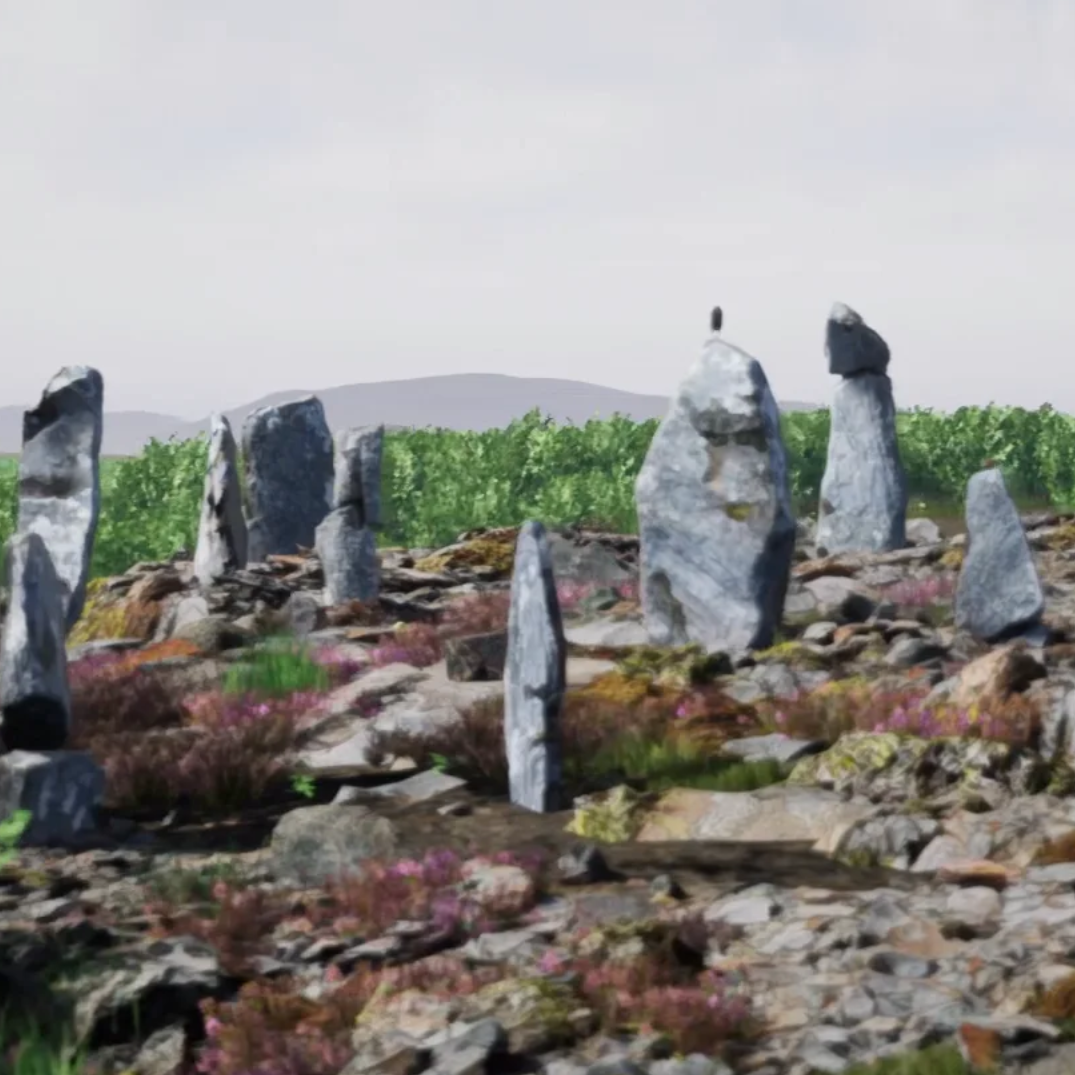
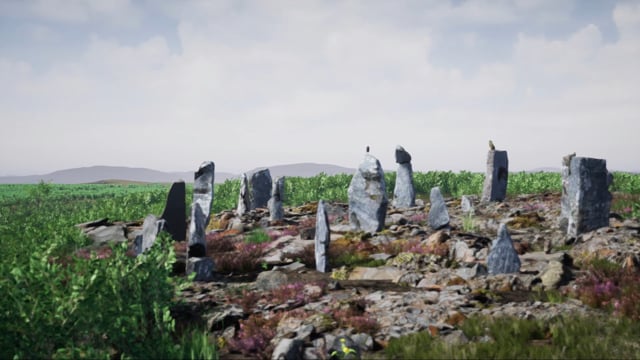
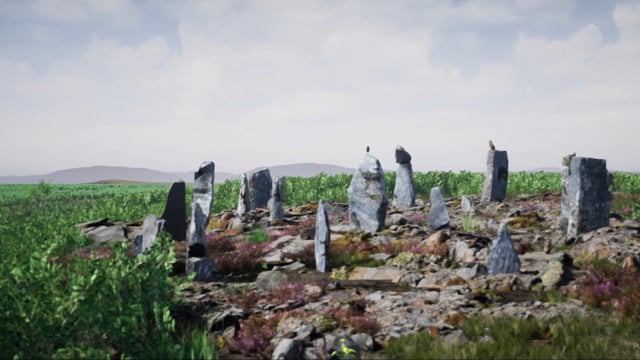
The surrounding landscape contains the remains of several other megalithic structures, including the former stone circle now called Callanish X or Na Dromannan. The stones at Callanish X now lie on their sides but are thought to have once stood upright. These stones have now been scanned as part of the Calanais Virtual Reconstruction Project. Using 3D models of the stones and drone footage of the surrounding landscape, we created a digital reconstruction of how the stones may have appeared when they were in their original locations.
The Calanais Virtual Reconstruction Project was a collaboration between Urras nan Tursachan (the trust which runs the Calanais Visitor Centre), the University of Bradford, and the University of St Andrews. The project was led by Dr Richard Bates from the University of St Andrews’ School of Earth and Environmental Sciences, and was funded by Highlands and Islands Enterprise.
Source
reconstructions
Date
2017
Format
image/png
Type
Reconstruction
Identifier
180
License
In Copyright (InC)
Spatial Coverage
current,58.20224654059231,-6.74551699042794;
Europeana
Is Shown At
https://www.openvirtualworlds.org/callanish-site-10-neolithic/
Object
https://player.vimeo.com/video/273858929
Europeana Rights
Open Virtual Worlds Team University of St Andrews
Europeana Type
TEXT
Reconstruction Item Type Metadata
Canmore
https://canmore.org.uk/site/4166
How
Our creation of the VR Standing Stones was part of a larger project - The Calanais Virtual Reconstruction Project.
The Calanais Virtual Reconstruction Project, a joint venture led by the University of St Andrews, the Urras nan Tursachan and the University of Bradford, with funding from Highlands and Islands Enterprise, uncovered a potential link between ancient stone circles and the forces of nature.
As many of the stones forming the circle had fallen flat over time. We were able to virtually recreate the stone circle, which had been lost with its stones either buried or lying flat.
Careful scanning of the stones allowed a full 3D landscape and model to be built, re-standing the stones as they were once located, allowing the passage of the sun and moon around this circle to be tracked for the first time in four millennia.
Evidence
Project leader Dr Richard Bates, of the School of Earth and Environmental Sciences at the University of St Andrews, said: “Such clear evidence for lightning strikes is extremely rare in the UK and the association with this stone circle is unlikely to be coincidental.
“Whether the lightning at Site XI focused on a tree or rock which is no longer there, or the monument itself attracted strikes, is uncertain.
“However, this remarkable evidence suggests that the forces of nature could have been intimately linked with everyday life and beliefs of the early farming communities on the island.”
Dr Bates added: “For the first time in over 4000 years, the stones can now be seen and ‘virtually’ walked around".
More information here: https://news.st-andrews.ac.uk/archive/ancient-secret-of-stone-circles-revealed/
Advisers
Richard Bates (University of St Andrews)
Date Represented
Neolithic
Collection
Citation
“Callanish Stone Circle,” STAGE, accessed October 16, 2026, https://stage.openvirtualworlds.org/omeka/items/show/212.
Embed
Copy the code below into your web page