Mount Fuji
Dublin Core
Title
Mount Fuji
Subject
Immovable Culture Heritage
Description
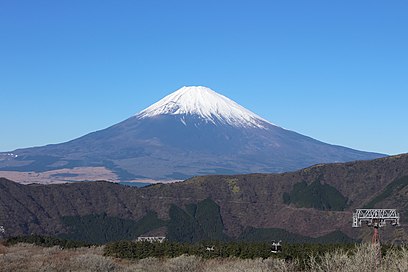
Mount Fuji is an active stratovolcano located on the Japanese island of Honshu, with a summit elevation of 3,776.24 m (12,389 ft 3 in). It is the tallest mountain in Japan, the second-highest volcano located on an island in Asia (after Mount Kerinci on the Indonesian island of Sumatra), and seventh-highest peak of an island on Earth. Mount Fuji last erupted from 1707 to 1708. The mountain is located about 100 km (62 mi) southwest of Tokyo and is visible from the Japanese capital on clear days. Mount Fuji's exceptionally symmetrical cone, which is covered in snow for about five months of the year, is commonly used as a cultural icon of Japan and is frequently depicted in art and photography, as well as visited by sightseers, hikers and mountain climbers.
Mount Fuji is one of Japan's "Three Holy Mountains" along with Mount Tate and Mount Haku. It is a Special Place of Scenic Beauty and one of Japan's Historic Sites. It was added to the World Heritage List as a Cultural Site on June 22, 2013. According to UNESCO, Mount Fuji has "inspired artists and poets and been the object of pilgrimage for centuries". UNESCO recognizes 25 sites of cultural interest within the Mount Fuji locality. These 25 locations include the mountain and the Shinto shrine, Fujisan Hongū Sengen Taisha.
Source
is51102024
Contributor
Xiaotong
Type
Site
Identifier
1053
Date Submitted
02/05/2024
References
https://en.wikipedia.org/wiki/Mount_Fuji
Extent
cm x cm x cm
Spatial Coverage
current,35.154947570992306,138.72436422854665;
Europeana
Europeana Data Provider
Mount Fuji
Europeana Type
TEXT
Site Item Type Metadata
Institutional nature
Place Name
Status
public
Condition
1
Contact
xy58@st-andrews.ac.uk
Collection
Citation
“Mount Fuji,” STAGE, accessed October 17, 2026, https://stage.openvirtualworlds.org/omeka/items/show/2193.
Embed
Copy the code below into your web page