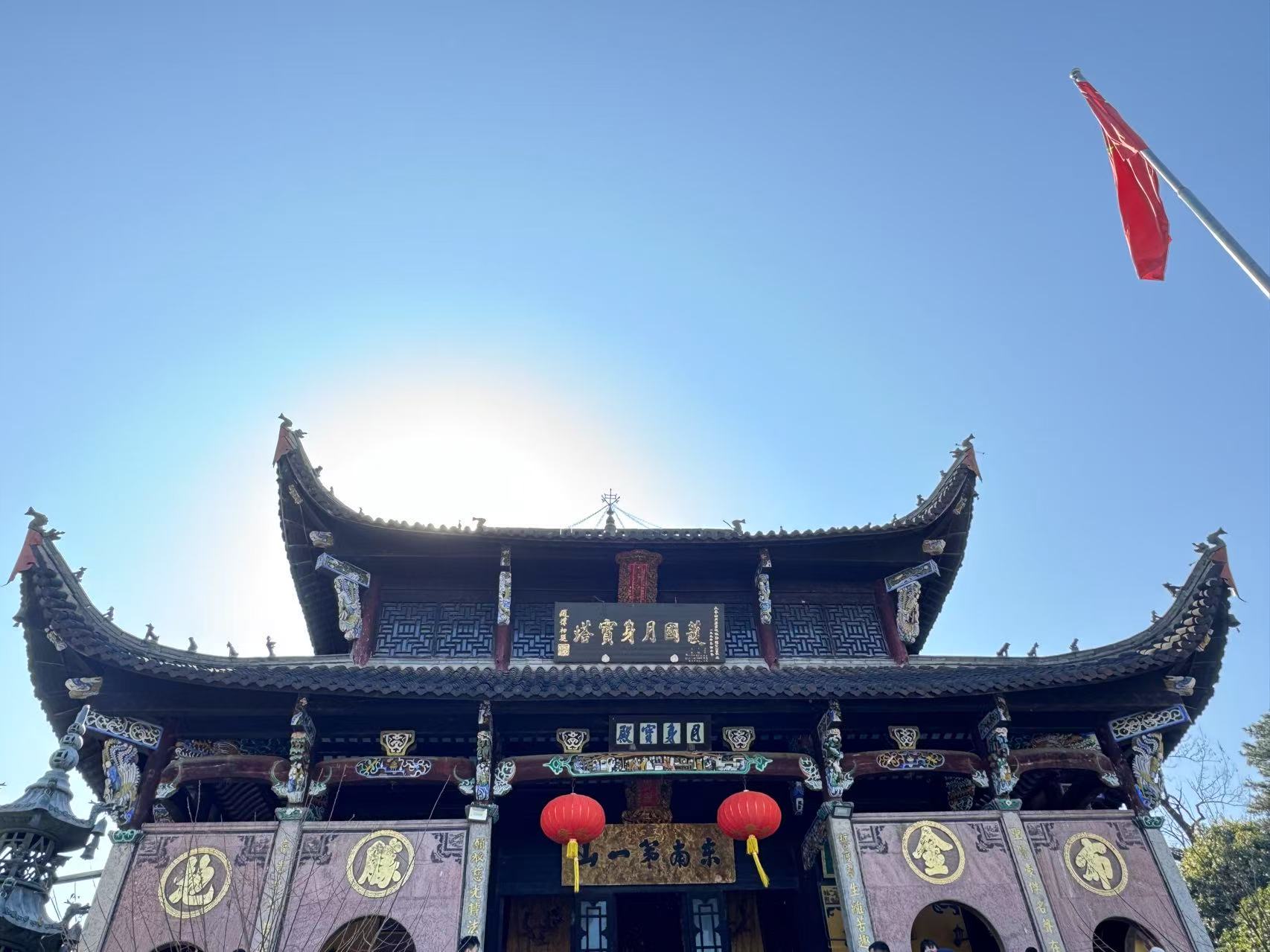
Front View of Dizang Hall, Jiuhua Mountain, China
Dublin Core
Title
Front View of Dizang Hall, Jiuhua Mountain, China
Subject
Immovable Culture Heritage
Description
The Flesh-Body Hall (Roushen Baodian) of Jiuhua Mountain, also known as the Dizang Hall, enshrines the mummified body of the Tang Dynasty monk Kim Qiaojue, revered as the incarnation of Kṣitigarbha Bodhisattva. After practicing for 75 years at Jiuhua, his body remained intact after death and became a central object of veneration. Built in the Qing Dynasty, the hall is a masterpiece of traditional Hui-style architecture, featuring curved eaves, intricate wood carvings, and symbolic decorative elements. It is one of the most significant pilgrimage destinations for Buddhists across China. The red lanterns and the Chinese national flag in front of the temple represent the blending of ancient religious devotion and modern cultural identity. This site holds not only deep spiritual meaning but also tangible historical and architectural value. Digital preservation of the temple—through 3D scanning, virtual walkthroughs, and annotated interpretation—can help foster global understanding of Chinese Buddhism while contributing to the sustainable safeguarding of immovable heritage.
Source
is51102025
Date
2025-01-16
Contributor
lw286@st-andrews.ac.uk
Format
image/jpeg
Type
Still Image
Date Submitted
03/24/2025 07:31:54 pm
License
Creative Commons Attribution License
Medium
Photo taken by myself
Spatial Coverage
current,30.461429,117.808097;
Europeana
Europeana Rights
Lei Wang
Europeana Type
IMAGE
Still Image Item Type Metadata
DescriptionEN
The Flesh-Body Hall (Roushen Baodian) of Jiuhua Mountain, also known as the Dizang Hall, enshrines the mummified body of the Tang Dynasty monk Kim Qiaojue, revered as the incarnation of Kṣitigarbha Bodhisattva. After practicing for 75 years at Jiuhua, his body remained intact after death and became a central object of veneration. Built in the Qing Dynasty, the hall is a masterpiece of traditional Hui-style architecture, featuring curved eaves, intricate wood carvings, and symbolic decorative elements. It is one of the most significant pilgrimage destinations for Buddhists across China. The red lanterns and the Chinese national flag in front of the temple represent the blending of ancient religious devotion and modern cultural identity. This site holds not only deep spiritual meaning but also tangible historical and architectural value. Digital preservation of the temple—through 3D scanning, virtual walkthroughs, and annotated interpretation—can help foster global understanding of Chinese Buddhism while contributing to the sustainable safeguarding of immovable heritage.
Citation
“Front View of Dizang Hall, Jiuhua Mountain, China,” STAGE, accessed October 21, 2026, https://stage.openvirtualworlds.org/omeka/items/show/3226.
Embed
Copy the code below into your web page