St Kilda
Dublin Core
Title
St Kilda
Subject
Immovable Culture Heritage
Description
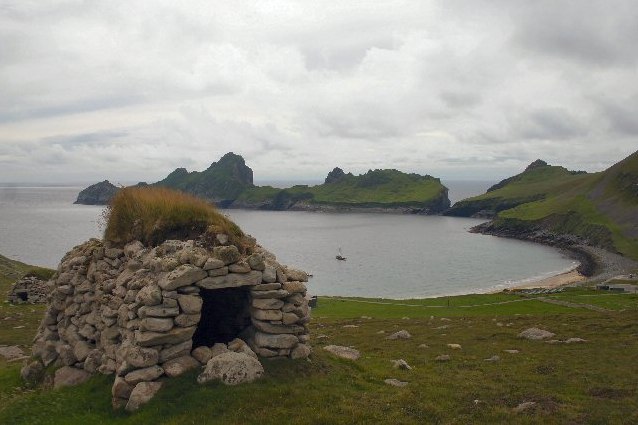
St Kilda, a remote volcanic archipelago, lies approximately 100 miles off the west coast of Scotland. It is made up of islands such as Soay, Boreray, Hirta, Dun, and Levenish. The archipelago boasts breathtaking sceneries and Europe's highest sea cliffs. These cliffs serve as vital nesting grounds for numerous seabirds, including puffins and gannets, endowing St Kilda with significant avian biodiversity. With over 2,000 years of human habitation in harsh conditions, the islands retain remnants like architectural structures, field systems, cleits (stone storage rooms), and traditional Highland stone houses. In 1930, the last inhabitants left. Recognizing its unique natural and cultural values, UNESCO listed St Kilda as a World Heritage Site in 1986, and added its marine environment and cultural landscape in 2004 and 2005.
To preserve it digitally, initiatives like the Scottish Ten Project have employed 3D laser scanning. This creates digital models of structures and archaeological features, allowing virtual tours. Such efforts, in line with UN SDG 11, boost sustainable tourism and education while safeguarding the world's cultural and natural heritage.
Source
is51102025
Date
2006:12:30 16:59:37
Contributor
zl203@st-andrews.ac.uk
Format
image/jpeg
Type
Still Image
Date Submitted
03/25/2025 12:30:25 am
License
Creative Commons Attribution-ShareAlike License
Medium
Wikipedia
Spatial Coverage
current,57°48′54″N,08°35′15″W;
Europeana
Is Shown At
https://en.wikipedia.org/wiki/St_Kilda,_Scotland
Object
https://en.wikipedia.org/wiki/St_Kilda,_Scotland#/media/File:Cleit_above_Village_Bay.jpg
Europeana Rights
Bob Jones
Europeana Type
IMAGE
Still Image Item Type Metadata
DescriptionEN
St Kilda, a remote volcanic archipelago, lies approximately 100 miles off the west coast of Scotland. It is made up of islands such as Soay, Boreray, Hirta, Dun, and Levenish. The archipelago boasts breathtaking sceneries and Europe's highest sea cliffs. These cliffs serve as vital nesting grounds for numerous seabirds, including puffins and gannets, endowing St Kilda with significant avian biodiversity. With over 2,000 years of human habitation in harsh conditions, the islands retain remnants like architectural structures, field systems, cleits (stone storage rooms), and traditional Highland stone houses. In 1930, the last inhabitants left. Recognizing its unique natural and cultural values, UNESCO listed St Kilda as a World Heritage Site in 1986, and added its marine environment and cultural landscape in 2004 and 2005.
To preserve it digitally, initiatives like the Scottish Ten Project have employed 3D laser scanning. This creates digital models of structures and archaeological features, allowing virtual tours. Such efforts, in line with UN SDG 11, boost sustainable tourism and education while safeguarding the world's cultural and natural heritage.
Citation
“St Kilda,” STAGE, accessed October 16, 2026, https://stage.openvirtualworlds.org/omeka/items/show/3260.
Embed
Copy the code below into your web page