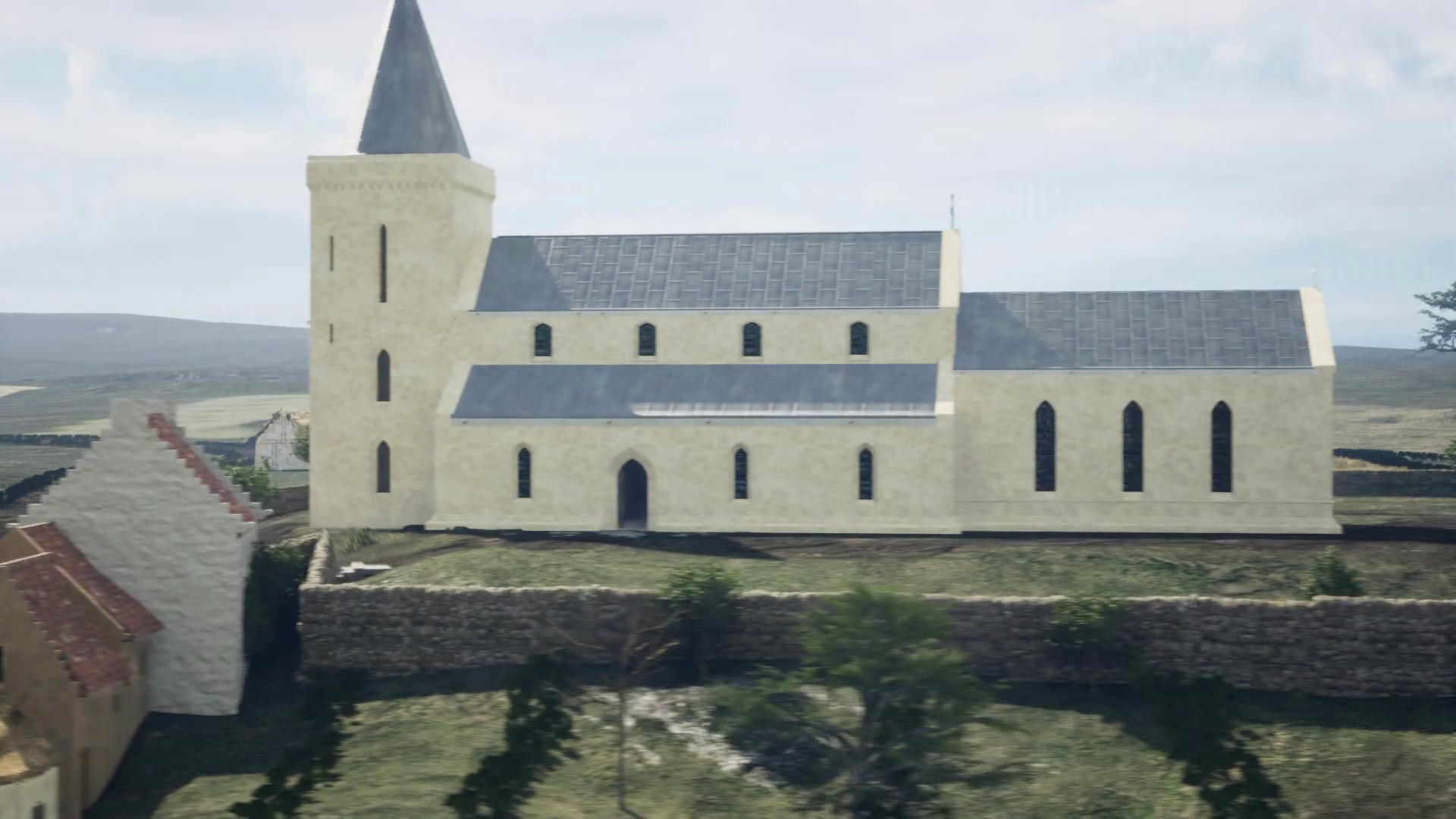
Kirkcaldy Old Kirk - 1500
Dublin Core
Title
Kirkcaldy Old Kirk - 1500
Subject
Intangible Heritage
Description
Medieval parish churches were hubs of activity within their communities. All adults were supposed to attend mass each Sunday and on feast days (although, of course, not everyone did!), and the major events of most people’s lives, from christening to funeral, were marked within the church. Socialising, business deals, and even disputes all regularly took place around – or in the middle of – weekly religious observances. The church was not empty on weekdays, either: the parish clergy said, or sang, multiple religious services each day, in a cycle known as the Divine Office. These services were often performed privately by the clergy at the altar, but members of the community who wished to spend time in personal devotion, along with pilgrims who were passing through on their way to St Andrews, would have been welcome here in the nave.
Source
reconstructions
Date
2023
Type
Reconstruction
Identifier
1490
License
In Copyright (InC)
Spatial Coverage
current,56.1125385,-3.1584624;
Europeana
Object
https://openvirtualworlds.viewin360.co/share/collection/7F13V?logo=1&info=0&fs=1&vr=1&sd=1&initload=0&thumbs=1
Europeana Rights
Open Virtual Worlds Team University of St Andrews
Europeana Type
TEXT
Reconstruction Item Type Metadata
How
Firstly, a digital landscape was created using survey data and height maps.
Following extensive historical research and collaboration with specialists, 3D models are created and imported into UNREAL Engine (a cross-platform game engine for creating virtual worlds). Models are textured, scaled, oriented and assembled. Scenes are created and populated with appropriate objects, including furniture and artefacts. Landscapes populated with flora and fauna. Weather settings and atmospheric lighting.
Clothing and characters researched, created, imported and animated.
Evidence
This reconstruction was a collaboration with Kirkcaldy Old Kirk Trust, with architectural guidance from Prof Richard Fawcett. Clothing research and illustrations by Perin Westerhof Nyman.
One of the rights of a Scottish burgh was a monopoly on all trade in the surrounding area: this meant that anyone who wanted to buy or sell goods in the vicinity of the burgh had to come to the burgh market. As a result, burghs became centres for a range of crafts, including tanning, brewing, pottery production, joinery, metalsmithing of various kinds, cobbling (shoemaking), and tailoring. The craftsmen and craftswomen who worked in these trades often formed guilds to regulate quality and pricing, and to provide support for one another. Burghs also attracted trade from further afield: in particular, Scotland’s eastern ports received shipments of items like fruit, cloth, and luxury goods from French and Flemish producers.
Although we lack surviving images that show how Scots dressed in this period, we know from written descriptions that the fashions worn in the lowlands, and particularly those favoured by wealthier burgh-dwellers, were broadly similar to those worn by their French and Flemish neighbours. These fashions reflect a point of transition in clothing production: they retain many similarities with earlier, geometrically-cut styles, but they also show some elements of the new methods of garment shaping that became increasingly fashionable in the later 15th and 16th centuries, including the use of waist seams and pleated skirts to create more exaggerated silhouettes.
Advisers
Prof Richard Fawcett, Perin Westerhof Nyman (University of St Andrews)
Date Represented
1500
Citation
“Kirkcaldy Old Kirk - 1500,” STAGE, accessed October 18, 2026, https://stage.openvirtualworlds.org/omeka/items/show/3973.
Embed
Copy the code below into your web page