The Church at Velika Castle, Larissa, Greece
Dublin Core
Title
The Church at Velika Castle, Larissa, Greece
Subject
Intangible Heritage
Description
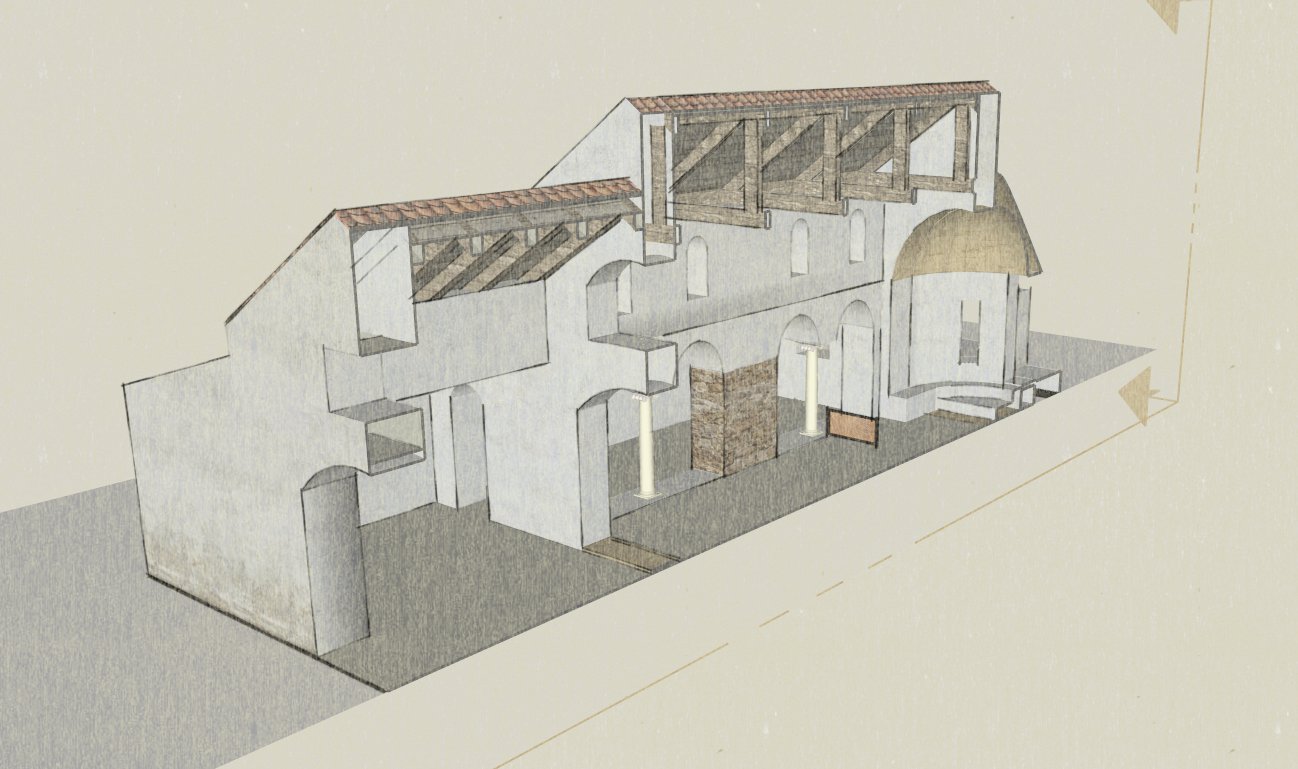
Velika castle occupies a hilltop overlooking the Aegean near the modern coastal settlement of the same name in the modern prefecture of Larissa. The castle is certainly founded in the Hellenistic period, but only small fragments of the ramparts of this era have been uncovered to date. Its main construction phase dates to the sixth century AD, confirmed by the results of the research of the 7th Ephorate of Byzantine Antiquities conducted there since 2010. A late antique church is situated in the northeast corner of the fortified settlement, just beside a secondary gate of the walls. It is a three-aisled basilica ending in a semicircular apse to the east and with a narthex in the west. Remnants of the altar and the sanctuary as well as the constructed base of the ambo (pulpit) in the south part of the nave have been revealed through excavation. The apse has a peculiar orthogonal projection which had been embraced by the city walls of the settlement at a later period; the east wall of the north aisle has a small window, while the same wall of the south aisle has a door leading to the corridor behind the ramparts. The church is presumably founded in the second part of the sixth century; the major part of the pottery and the findings are dating from the age of Justinian up to the end of the century. The church underwent a major transformation at a later date, possibly at the end of the seventh or the beginning of the eighth century: it then became a single-nave church, since the side aisles were transformed into living quarters and storerooms; many amphorae and large storage ceramics have been found in the filling layers along with every-day artefacts (fishing hooks and belt buckles) and a small hearth at the northwest corner of the north aisle.
Source
is51102025
Date
2014
Format
image/jpeg
Type
Reconstruction
Identifier
1539
License
In Copyright (InC)
Spatial Coverage
current,39.791333326763876,22.85435736179352;
Europeana
Europeana Type
TEXT
Reconstruction Item Type Metadata
How
In 2014, using archaeological data and guidance provided by specialist adviser Dr Ioannis (Yannis) Varalis, we were able to create a scaled and accurate version of how we believe the church at Velika would have looked. This model was developed in SketchUp 2014.
Evidence
This basilica is the only systematically excavated at the Aegean coast of Thessaly in the last fifty years. Moreover, its renovation dates to a period of a special interest for the Balkans, as well as for Thessaly in particular. The church seems to have been renovated in a period when the settlement had been subjected to Slavic incursions, mainly the Velegezetai Slavs who settled in Thessaly, according to the text of the Miracula Sancti Demetrii composed in the early seventh-century Thessalonike. The fortified settlement on Velika hill in all probability continued to exist until the mid-eighth century at the latest.
Dr Yannis Varalis, Assistant Professor in Byzantine Archaeology at the University of Thessaly, and Dr Stavroula Sdrolia, Head of the 7th Ephorate of Byzantine Antiquities, Larissa, have collaborated in the basilica’s excavation since 2011.
Advisers
Dr Ioannis (Yannis) Varalis (University of Thessaly, Volos, Greece) Rebecca Sweetman (University of St Andrews)
Date Represented
sixth century AD
Citation
“The Church at Velika Castle, Larissa, Greece,” STAGE, accessed October 16, 2026, https://stage.openvirtualworlds.org/omeka/items/show/4155.
Embed
Copy the code below into your web page