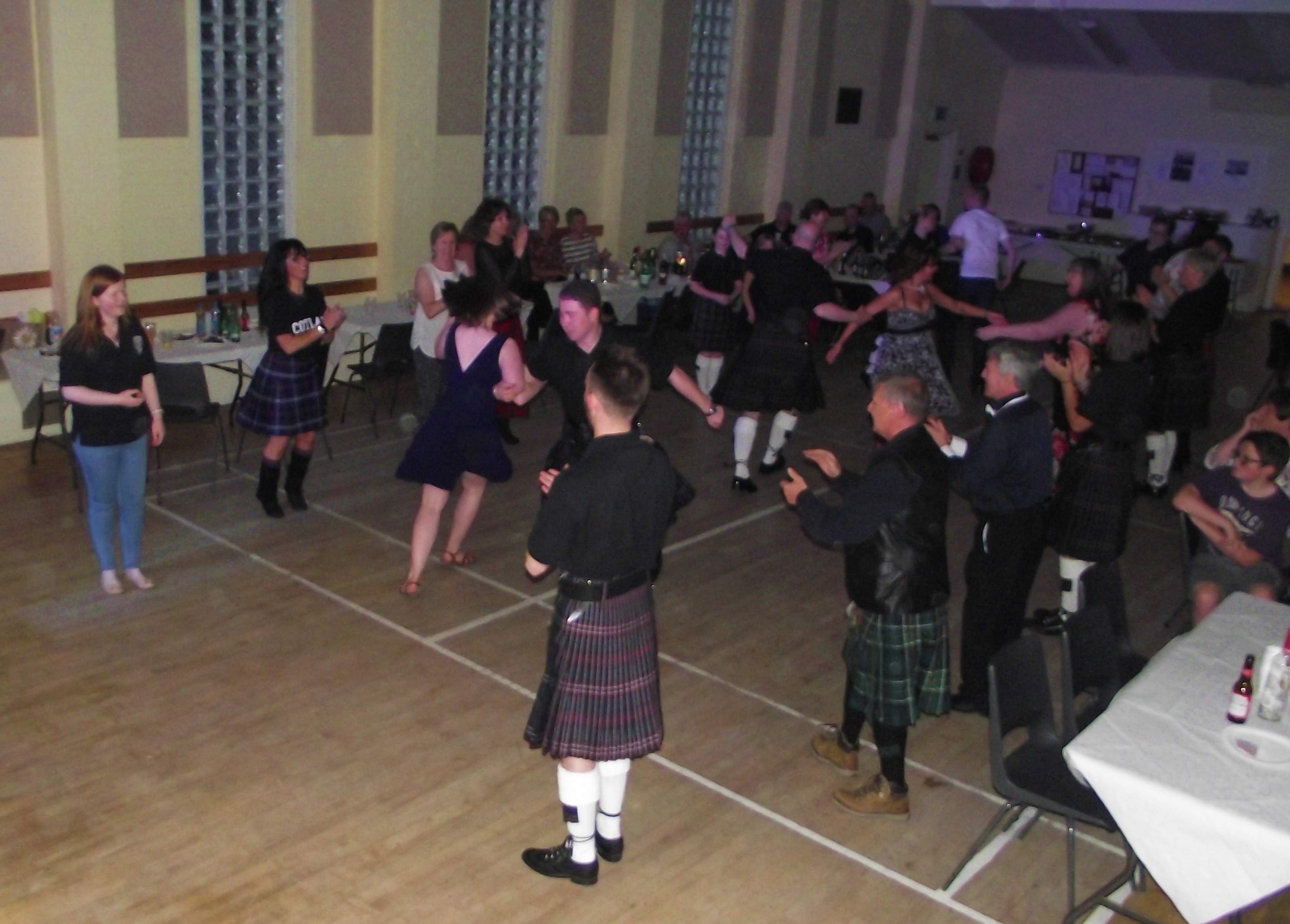
Northern Constabulary Pipe Band Fundraising Ceilidh at North Kessock near Inverness Scotland
Dublin Core
Title
Northern Constabulary Pipe Band Fundraising Ceilidh at North Kessock near Inverness Scotland
Subject
Intangible Heritage
Description
Image shows people in the middle of a ceilidh dance at the Northern Constabulary Community Pipe Band's Fundraising Ceilidh in North Kessock. Several people are wearing traditional Scottish attire such as Kilts.
Ceilidhs are an informal form of dancing which is very popular in Scotland. The word ceilidh comes from Gaelic and traditionally referred to a gathering of people in the home. There is no exact location for all ceilidhs as they can be in any place at any time, I have chosen this location on the map as the Northern Constabulary Pipe Band Fundraising Ceilidh took place here.
Traditionally, neighbours would come together in the evening to informally share songs, music, poetry and storytelling around the fire. Dancing did not always occur. However, in larger communities in rural parts of Scotland, these gatherings were later held in halls and people would dance well known ceilidh dances such as “the gay gordons” and “the dashing white sergent”. The earliest reference to the “gay gordons” is from the early 20th century. The dashing white sergent’s earliest reference is the late 19th century, but it is based on very old Scottish formations of “setting” and “reeling”, which date back to the 1700s. Anyone can join a ceilidh dance and although it is an informal dance, most ceilidhs today are run by a caller who is responsible for selecting the dance and providing basic instructions to ensure that everyone can participate and enjoy the dance.
Source
wordlheritage2022
Date
2016:06:18 22:42:13
Contributor
lj77
Format
image/jpeg
Type
Still Image
License
Creative Commons Attribution License
Medium
https://commons.wikimedia.org/wiki/File:Northern_Constabulary_Pipe_Band_Fundraising_Ceilidh_at_North_Kessock_near_Inverness_Scotland_(27162471004).jpg
Spatial Coverage
current,57.502337,-4.253683;
Europeana
Is Shown At
https://www.bbc.co.uk/bitesize/guides/z9h92nb/revision/1, https://www.rscds.org/get-involved/ceilidh-dancing/popular-ceilidh-dances
Europeana Provider
https://www.flickr.com/people/91779914@N00
Europeana Rights
Dave Conner
Europeana Type
IMAGE
Still Image Item Type Metadata
DescriptionEN
Image shows people in the middle of a ceilidh dance at the Northern Constabulary Community Pipe Band's Fundraising Ceilidh in North Kessock. Several people are wearing traditional Scottish attire such as Kilts.
Ceilidhs are an informal form of dancing which is very popular in Scotland. The word ceilidh comes from Gaelic and traditionally referred to a gathering of people in the home. There is no exact location for all ceilidhs as they can be in any place at any time, I have chosen this location on the map as the Northern Constabulary Pipe Band Fundraising Ceilidh took place here.
Traditionally, neighbours would come together in the evening to informally share songs, music, poetry and storytelling around the fire. Dancing did not always occur. However, in larger communities in rural parts of Scotland, these gatherings were later held in halls and people would dance well known ceilidh dances such as “the gay gordons” and “the dashing white sergent”. The earliest reference to the “gay gordons” is from the early 20th century. The dashing white sergent’s earliest reference is the late 19th century, but it is based on very old Scottish formations of “setting” and “reeling”, which date back to the 1700s. Anyone can join a ceilidh dance and although it is an informal dance, most ceilidhs today are run by a caller who is responsible for selecting the dance and providing basic instructions to ensure that everyone can participate and enjoy the dance.
Collection
Citation
“Northern Constabulary Pipe Band Fundraising Ceilidh at North Kessock near Inverness Scotland,” STAGE, accessed October 16, 2026, https://stage.openvirtualworlds.org/omeka/items/show/725.
Embed
Copy the code below into your web page