Steel Pan
Dublin Core
Title
Steel Pan
Subject
Movable Cultural Heritage
Description
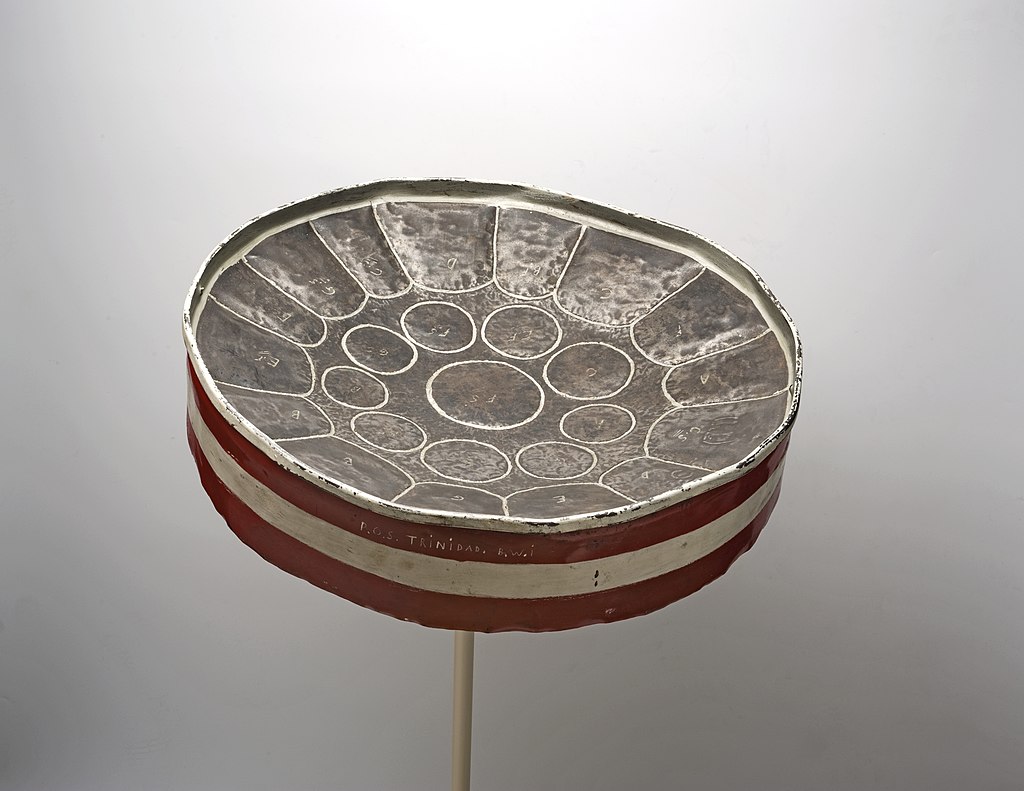
Following emancipation in 1834, former slaves were allowed to participate in the Trinidad Carnival, however African-descended percussive performance was heavily targeted by restrictive government bills which banned many common percussive instruments (Google 2022). Having used improvisational instruments for years, by the 1930s Trinidadians experimented with a new improvisational instrument as they began to adapt oil drums to create the first steel pans. Trinidadians realised that the convex dent at the bottom of the oil drums would cause a sustained resonance when struck with a wooden “stick” or “beater”. They then experimented to tune these resonances to distinct musical pitches and could then produce recognisable melodies. The process is laborious but tedious, as the metal is heated and hammered into place, but also tuned with more precise, delicate hammering.
Google 2022. The Origins of Steel Pan Notting Hill Carnival. Accessed 2022. https://artsandculture.google.com/story/the-origins-of-steel-pan-notting-hill-carnival/AAWBxQd4TKb21w?hl=en.
Source
wordlheritage2022
Date
30 March 2018
Contributor
mac37
Format
image/jpeg
Type
Still Image
Date Submitted
04/30/2022 12:57:22 pm
License
Creative Commons Attribution-ShareAlike License
Medium
https://commons.wikimedia.org/wiki/File:Collectie_Nationaal_Museum_van_Wereldculturen_TM-2586-1_Steel_drum_Trinidad.jpg
Spatial Coverage
origin,10.643658221190414,-61.139330752193935;
Europeana
Is Shown At
https://commons.wikimedia.org/wiki/File:Collectie_Nationaal_Museum_van_Wereldculturen_TM-2586-1_Steel_drum_Trinidad.jpg
Object
https://commons.wikimedia.org/wiki/File:Collectie_Nationaal_Museum_van_Wereldculturen_TM-2586-1_Steel_drum_Trinidad.jpg
Europeana Provider
https://www.tropenmuseum.nl/nl/over-het-tropenmuseum/stichting-nationaal-museum-van-wereldculturen
Europeana Rights
Nationaal Museum van Wereldculturen
Europeana Type
IMAGE
Still Image Item Type Metadata
DescriptionEN
Following emancipation in 1834, former slaves were allowed to participate in the Trinidad Carnival, however African-descended percussive performance was heavily targeted by restrictive government bills which banned many common percussive instruments (Google 2022). Having used improvisational instruments for years, by the 1930s Trinidadians experimented with a new improvisational instrument as they began to adapt oil drums to create the first steel pans. Trinidadians realised that the convex dent at the bottom of the oil drums would cause a sustained resonance when struck with a wooden “stick” or “beater”. They then experimented to tune these resonances to distinct musical pitches and could then produce recognisable melodies. The process is laborious but tedious, as the metal is heated and hammered into place, but also tuned with more precise, delicate hammering.
Google 2022. The Origins of Steel Pan Notting Hill Carnival. Accessed 2022. https://artsandculture.google.com/story/the-origins-of-steel-pan-notting-hill-carnival/AAWBxQd4TKb21w?hl=en.
Citation
“Steel Pan,” STAGE, accessed October 16, 2026, https://stage.openvirtualworlds.org/omeka/items/show/770.
Embed
Copy the code below into your web page