The Main Lines
Chartres is a sanctuary so old that its origins, in the Gallic era, see history and legend confused.
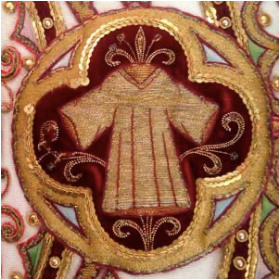
As early as the fourth century, a bishop was present there. We know that very old the cathedral was already dedicated to Mary. However, it was around 876, with the donation to Chartres of the ‘Chemise de Notre-Dame’, which came from Constantinople, that it became – in the minds of the inhabitants and the first pilgrims, “her home on Earth“.
The crypt of the cathedral, even if it includes older parts, dates from the 1020s. It was Bishop Fulbert who then imagined a new building of exceptional magnitude (after the disappearance of four or five others that preceded him).
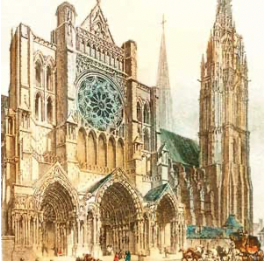
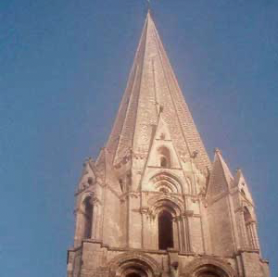
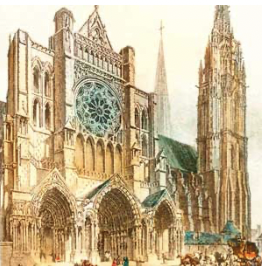
Around 1134/1150, a new facade came out of the ground, which testifies to an exceptional ambition. The spire (south) is one of the tallest buildings ever built. The so-called ‘royal’ portal presents a sculpture synthesis of Christian thought. Three large stained glass windows of an unprecedented size, complete the whole.
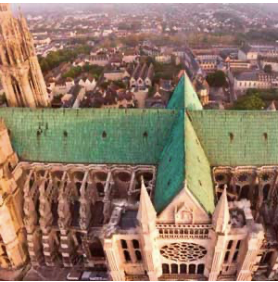
The Gothic cathedral was built from 1194, following a fire that made the old Fulbert Cathedral disappear – with the exception of the facade and the lower floor. All possible means are allocated to this project, which is completed in less than 25 years: a unique fact for a large cathedral. The structural work, the large north and south portals, as well as all (or almost) of the stained glass windows date from this period.
At the beginning of the 16th century, the second arrow, more worked, was made, which definitively gave Chartres its silhouette.
Inside the cathedral, the ‘choir tower’ tells the life of Jesus and Mary.
The cathedral (with the exception of the treasure and relics) suffers relatively little from the French Revolution.
At the end of the 19th century, Chartres established itself among art historians as the best preserved cathedral. From 1856, it welcomed many pilgrims again.
The Big Dates
2000 years of history that marked the construction and history of Notre-Dame.
from the 1st century to the year one thousand
Chartres is the capital of the Gallo-Roman city of Les Carnutes [Lyon region]. Evangelization – legendary – by Saints Savinian and Potentian.
743:
First mention in the texts. The cathedral was destroyed by a raid by Hunald, Duke of Aquitaine. The building is dedicated to ‘Sainte Marie’.
858:
Destruction by the Vikings. The cathedral was rebuilt by Bishop Gislebert.
876:
King Charles the Bald offers a relic that plays a decisive role in the history of the cathedral: the ‘Veil of the Virgin’.
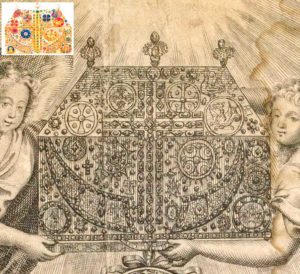
former reliquary of the veil of the Virgin
911:
Siege of Chartres by the Danish Rollon, who shortly after became Duke of Normandy. He raises the seat after Bishop Goussaume showed the veil of the Virgin on the ramparts. This event is considered a miracle.
962:
Destruction of the Carolingian cathedral during the hostilities declared between Richard, Duke of Normandy and Thibaut the Cheater, Count of Chartres.
End of the fourth century:
Probable date of the first cathedral, at its current location.
911:
Siege of Chartres by the Danish Rollon, who shortly after became Duke of Normandy. He raises the seat after Bishop Goussaume showed the veil of the Virgin on the ramparts. This event is considered a miracle.
962:
Destruction of the Carolingian cathedral during the hostilities declared between Richard, Duke of Normandy and Thibaut the Cheater, Count of Chartres.
in the 11th century
1006 – 1029:
Fulbert’s Episcopate. Of a rare intellectual scope, this bishop, whose extensive correspondence and several poems have been preserved, has profoundly marked the siege of Chartres.
1020:
Following a fire, Bishop Fulbert inaugurated the construction site of the Romanesque cathedral, one of the largest in Europe, of which he remains today the low church. A letter suggests that this long corridor, winding around the older remains, was completed in the autumn of 1024.
1037:
Consecration of the Romanesque cathedral. It is covered with a frame.
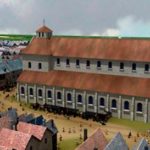
restitution of Fulbert Cathedral
in the 12th century
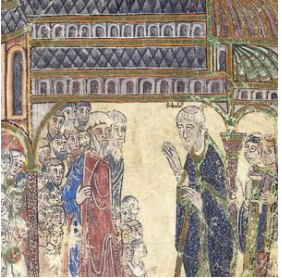
The episcopal school reaches a high level of development. It studies the texts of Antiquity and the High Middle Ages: Boethia, Isidore of Seville, Donat, Priscian, Cicero, Aristotle. Several personalities are necessary: Bernard de Chartres and his brother Thierry, author of the Eptateuchon, Gilbert de la Porrée, Guillaume de Conches. We rediscover – indirectly – Greek texts, establishing a cosmogony that reconciles holy writing and Platonic thought. Above all, we inaugurate a scientific approach to the created Universe.
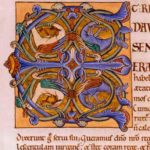
an illuminated manuscript from Chartres, around 1150 © BNF
1134:
Following the clearance of the forecourt, a new facade is built. Donations are allocated first to the north tower, then to the two towers. Between them, a narthex takes place, which disappeared in the 13th century.
1134:
Following the clearance of the forecourt, a new facade is built. Donations are allocated first to the north tower, then to the two towers. Between them, a narthex takes place, which disappeared in the 13th century.
1145:
Robert de Torigny, abbot of Mont Saint Michel, evokes the enthusiasm that reigns on the construction site. ‘It was in Chartres that we saw for the first time men dragging, by dint of arms, carts loaded with stones, wood, food and all the provisions necessary for the work of the church whose towers were raised’.
1145 – v. 1155:
Realization of the royal portal, a masterpiece of medieval sculpture – at the hinge of Romanesque and Gothic art.
1160:
Completion of the southern spire – the highest of the world’s buildings after the pyramids of Egypt.
1176 – 1180:
Episcopate of Jean de Salisbury, former secretary of Thomas Becket.
1194:
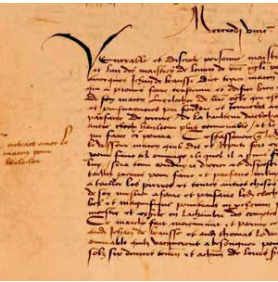
On June 10, fire of the Romanesque cathedral. The Veil of the Virgin is saved from destruction, after being sheltered in the central vault of the lower church.
preserved manuscript, with mention of the fire of 1194
According to the ‘Book of Miracles’, Bishop Renaud de Mousson and the canons, encouraged by the Pope’s legate, give back three years of their income.
1194 – v.1230:
Construction of the current cathedral, in an exceptionally short period of time – during which the annual campaigns follow one another: the construction site probably does not suffer any stoppage.
The researchers discussed at length about the phasing of work. The observation of the flying butters, as well as the dating of the wooden entries – the ends of which are taken in the masonry – allow two conclusions: the lower side precedes the ambulatory, larger and “lighter” than the initial project predicted; the upper parts of the nve are completed before those of the choir.
1199:
Preaching of the Fourth Crusade. Several lords, around the Count of Chartres, Louis de Blois, make important donations. They thus relay the financing of the bishop and the chapter, which has significant land income: the diocese of Chartres extends from the Loire to the Seine.
in the 13th century
1210:
Urban riot. The King of France, Philippe Auguste, comes to Chartres and contributes to “the work of building the said church“. The rioters and the provost pay a fine of 3,000 pounds.
1214 – 1217:
William the Breton, in the Philippide, praises the construction and in particular the vaults that are partially built: ´Emerging, new, the stone once razed and already completed as a whole, it has, under its splendid turtle shell, nothing to fear until the day of the Judgment of the damage of a fire ‘.
1221:
According to a deliberation of the chapter, the canons celebrate the services in the new choir. It has long been claimed that this date testified to the completion of the structural work.
1235 – 1240:
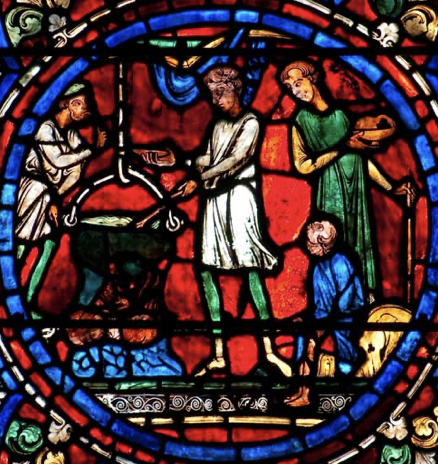
The stained glass windows of the cathedral are all laid, occupying 176 windows. On this date, the sculpted ensemble of the north and south porches, begun around 1205/10, has already been completed.
1245 – 1250:
The three gables of the cathedral are built: North, South and West – where there is a ‘gallery of kings’. It is probably from this period that the interior coatings of the cathedral date from: ochre with false white apparatus.
1260:
On October 17, consecration of the Gothic cathedral.
End of the 13th century:
A floor is added to the north tower of the main facade. The initial project included seven spires, in addition to those to the west (two in the south transept, two in the north transept, two on the sides of the choir, one at the crossroads of the transept). They will never be built.
from the 14th to the 17th century
1316:
Following some masonry disorders, especially at the lintels of the porches, an expertise is commissioned from several recognized architects. Metal reinforcements are installed.
1323:
Construction of the chapter room, located at the bedside of the cathedral. As early as 1335, the chapel of Saint Piat occupied the floor of the building. Located off-the-statione, its architecture testifies to the evolution of styles: radiant Gothic.
1366:
Turrets of the southern transept, by the architect Jean aux Tabours.
1417:
Construction of the Vendôme chapel between two buttresses on the lower side, following a wish from Count Louis de Bourbon.
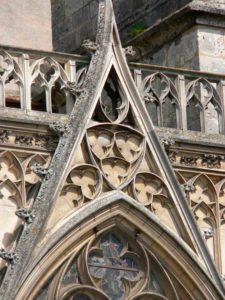
detail of the gable of the Vendôme chapel © NDC
1506 – 1513:
Construction of the north spire, by the architect Jehan Texier, known as Jehan de Beauce. 115 meters high. Its silhouette – flamboyant Gothic – contrasts with the southern spire.
1514:
(photo: histoire-1514-légende-tour-du-choeur-0703_49644815068_o.jpg) Beginning of the work of the ‘tour du chœur’. The lower part evolves from the flamboyant style to the renaissance style. In the upper part, the sculpted groups, which tell the story of Mary and Christ, were not completed until 1716. It is a remarkable testimony to the evolution of French art for two centuries.
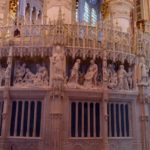
tour of the choir © NDC
16th century The cathedral receives the frequent visit of the kings of France: Francis I, Henry II and especially Henry III, who makes the pilgrimage many times.
1594:
On February 27, the coronation of King Henry IV. The coronation ceremonies took place at the cathedral of Reims. However, the city was in the hands of the ‘league’, unfavorable to the new king, barely converted from Protestantism.

engraving of the coronation of Henry IV in Chartres in 1594
from the 18th to the 19th century
1763:
Destruction of the 13th century jubé. Fragments, found in the paving of the cathedral in the 19th century, will be presented to the public in the coming years.s is the capital of the Gallo-Roman city of Les Carnutes [Lyon region]. Evangelization – legendary – by Saints Savinian and Potentian.
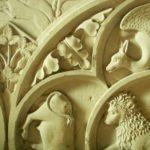
element of a preserved quadrilobe of the Gothic jube
1767 – 1773:
Redevelopment of the cathedral choir, according to the taste of the time, by architect Victor Louis. Gothic arcades take on a neoclassical appearance: red, grey and green stucco on the columns and corners; Corinthian capitals in gypsum and gilded wood. The group of the Assumption of the Virgin, made of Carrara marble, is commissioned from the sculptor Charles-Antoine Bridan. A golden ironwork grid – today in the south tower – closes the new choir of canons.
1786 – 1790:
Second phase of redevelopment of the choir. Low marble reliefs and installation of stalls.
1793:
The cathedral was disused, for several years – becoming on the occasion of a “Temple of Reason” event. The treasure is widely scattered. The Statue of Our Lady of Underland is burned. The Veil of the Virgin is torn: several pieces will return to the cathedral shortly before 1820.
1836:
The ‘great attic’ is destroyed by a fire. The Chamber of Deputies is moved by this, as is the writer Victor Hugo. The old frame is replaced by a metal structure, due to engineer Émile Martin. The copper cover quickly greens, giving its current silhouette to the cathedral.
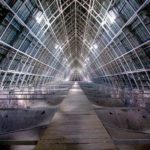
the metal frame
1854:
Coronation of Our Lady of the Pillar. A sentence by Monsignor Pie has a considerable impact: “I dare to predict, Chartres will become more than ever the center of devotion to Mary in the West, and we will flock to it as in the past from all parts of the world“.
1857:
Consecration of the new statue of Notre-Dame de Sous Terre.
1860:
Reopening of the crypt to worship, on the occasion of sumptuous ceremonies. This event inaugurates huge pilgrimages – more than 50,000 people are welcomed during the two days of May 27 and 28, 1873.
1895 – 1910:
Important restorations, carried out by the architect Selmersheim on the south and north porches.
1898:
Publication of a novel dedicated to Chartres: ‘The Cathedral’, by Joris-Karl Huysmans.
from the 20th to today
1935:
First ‘student pilgrimage’ following Charles Péguy.
1939:
Laying of stained glass windows of the cathedral to avoid their destruction by bombing. Moved to the Dordogne or stored in the crypt, they resumed their place in 1946/48.
1975:
Redevelopment of the crypt – Notre-Dame de Sous Terre.
1986:
Beginning of the restoration of the stained glass windows of the cathedral: low sides of the nave and transept (1986-1988), deambulatory (1990-2003), high choir (2004-2010).
1992:
Inauguration of the new altar, at the crossroads of the transept, the work of the goldsmith Goudji.
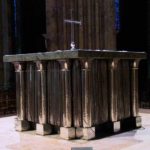
altar of the goldsmith Goudji
2006:
Inauguration of the new baptistery, in the crypt of the cathedral.
2008:
Beginning of the restoration of interior coatings.
All pictures are from: Cathédrale de Chartres. Cathédrale de Chartres. (2024, April 8). https://www.cathedrale-chartres.org/

Maybe you also want to know
Stained Glass Window
Architecture