The Camino de Santiago
Prototype for an exhibition exploring the Camino de Santiago’s rich heritage and the impact of Climate Change on the Routes.
|
|
The Camino de Santiago
The Camino de Santiago is a network of Christian Pilgrimage routes which cross through France and northern Spain to the city of Santiago de Compostela in Galicia, Spain. It began in the 9th century, following the discovery of a tomb believed to be that of the Apostle Saint James, near Padron in Galicia, Spain.
In Spain, four routes cross through the north to Santiago de Compostela, and one crosses through the Iberian Peninsula. Those are the Camino Primitivo, the Coastal way, the interior of the Basque Country-La Roja and Liebana, and the Camino Frances. In France, pilgrimage routes developed from the 11th century, with departures from le Puy-en-Vellay and Arles in the southern parts of the country, and from Vezelay and Tours in the centre-north. Today, additional routes depart from Portugal, Italy and southern Spain.
The Spanish portions of the routes were listed as UNESCO World Heritage sites in 1993, with the French routes added in 1998. The Old Town of the city of Santiago de Compostela was also listed in 1985.
Watch Google Arts & Culture presentation of the Camino from 2021:

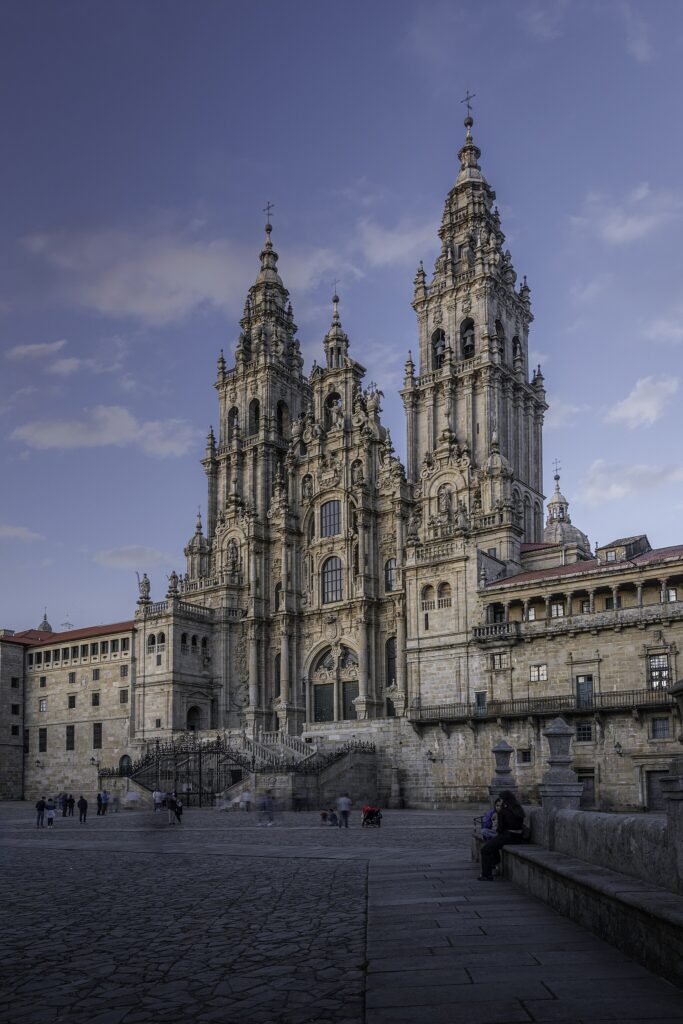
Santiago de Compostela
Santiago de Compostela is the capital of Galicia, Spain. It is situated in the northern parts of the country, alongside the Atlantic coast and above Portugal. The city origin is tied to the pilgrimage and the discovery of Saint James’ presumed tomb in the 9th century. The Old Town of Santiago de Compostela was destroyed in the 10th century by the Andalusian, and rebuilt in the 11th century. Today, the Old Town is a UNESCO World Heritage Site, and features an eclectic range of Romanesque, Gothic, Renaissance, Baroque and Neoclassical architectures, as well as many examples of Spanish and Galician craftmanship.
The Cathedral of Santiago de Compostela hosts the shrine of Saint James. It was built between 1075 and 1211. Explore the Cathedral in a 360 tour from The Catedral de Santiago Foundation on Google Arts & Culture.
Image: Santiago de Compostela Cathedral at Dusk by Fernando Pascullo, 30 April 2023 (see sources for full details).

Saint James
The Apostle James the Greater, Saint James – Saint Jacques in French and Santiago in Spanish – was one of the Twelve Apostles, and brother of Apostle Saint John. Saint James is the first Apostle to be martyred and the only Apostle whose martyrdom is recorded in the New Testament.
Saint James is the patron Saint of Galicia. His feast day is July 25th, and his symbol is the Scallop Shell. Both have become central parts of the Christian Pilgrimage to Santiago de Compostela, with the Feast of Saint James also standing as the National Day of Galicia.
Image: Peter Paul Rubens, St James the Apostle, c.1612-1613, oil on panel, 108cm x 84cm, Museo del Prado (see sources for full details).
Sources:
UNESCO World Heritage Convention, ‘Routes of Santiago de Compostela: Camino Francés and Routes of Northern Spain’, UNESCO World Heritage Convention. Accessed: Feb. 15, 2024. [Online]. Available: https://whc.unesco.org/en/list/669/
UNESCO World Heritage Centre, ‘Santiago de Compostela (Old Town)’, UNESCO World Heritage Centre. Accessed: Apr. 13, 2024. [Online]. Available: https://whc.unesco.org/en/list/347/
UNESCO World Heritage Convention, ‘Routes of Santiago de Compostela in France’, UNESCO World Heritage Convention. Accessed: Feb. 15, 2024. [Online]. Available: https://whc.unesco.org/en/list/868
‘Camino de Santiago Routes’, CaminoWays.com. Accessed: Apr. 13, 2024. [Online]. Available: https://caminoways.com/camino-de-santiago-routes
‘Santiago de Compostela | Pilgrimage, History & Culture | Britannica’. Accessed: Apr. 13, 2024. [Online]. Available: https://www.britannica.com/place/Santiago-de-Compostela
‘Saint James | Biography, Apostle, Death, & Facts | Britannica’. Accessed: Apr. 13, 2024. [Online]. Available: https://www.britannica.com/biography/Saint-James-son-of-Zebedee
Roland, ‘Who is Saint James?’, CaminoWays.com. Accessed: Apr. 13, 2024. [Online]. Available: https://caminoways.com/who-is-saint-james
Images:
Scallop shell banner designed by the author modifying: Cunchinha by Bululú Creativos, 2021. Licence: Public domain, via Wikimedia Commons. Modified. URL: https://commons.wikimedia.org/wiki/File:Cunchinha.png

Top banner: Por el Camino, by Random username 083794703875938, 31 July 2012. Licence: Public Domain via Wikimedia Commons. No Modification. URL: https://commons.wikimedia.org/wiki/File:Por_el_Camino_01_-_By_the_Way_01.jpg

Second banner: Santiago de Compostela Cathedral view from Alameda Park by Fernando Pascullo, 30 April 2023. Licence: CC BY-SA 4.0 https://creativecommons.org/licenses/by-sa/4.0, via Wikimedia Commons. No Modification. URL: https://commons.wikimedia.org/wiki/File:Santiago_Compostela_Cathedral_2023_-_View_from_Alameda_Park.jpg?uselang=es#filelinks

Third banner: Santiago de Compostela Cathedral – St James by Bjørn Christian Tørrissen 27 October 2021. Licence: CC BY-SA 4.0 https://creativecommons.org/licenses/by-sa/4.0, via Wikimedia Commons. No Modification. URL: https://commons.wikimedia.org/wiki/File:Santiago-Cathedral-St-James.jpg

Video: Google Arts & Culture, ‘Follow the footsteps of the walkers of CAMINO de SANTIAGO’ youtube video, 24 September 2021. Last Accessed 28 April 2024. https://youtu.be/LNWk7Ppt44I?si=WUdBDTANL9EjUrM9
Image 1: Santiago de Compostela Cathedral at Dusk by Fernando Pascullo, 30 April 2023. CC BY-SA 4.0 https://creativecommons.org/licenses/by-sa/4.0, via Wikimedia Commons. No Modification. URL: https://commons.wikimedia.org/wiki/File:Santiago_Compostela_Cathedral_2023_-Obradoiro_at_Dusk.jpg

Image 2: Peter Paul Rubens, St James the Apostle, c.1612-1613, oil on panel, 108cm x 84cm, Museo del Prado. Licence: Public Domain, via Wikimedia Commons. No Modification. URL: https://commons.wikimedia.org/wiki/File:Peter_Paul_Rubens_-St_James_the_Apostle-_WGA20192.jpg
