The Camino: A Plural Heritage
|
|

Natural Heritage
The pilgrimage boasts outstanding landscapes and is an important showcase of Southern Europe’s natural heritage. The routes cover a total of over 2,238km in Spain and 2,329km in France, with 9,146 hectares of these routes listed as UNESCO World Heritage Sites in Spain and 97.21 hectares in France. When departing from one of the four French cities, pilgrims can expect to complete around 1000km of routes to reach Santiago de Compostela.
A pilgrimage route will lead pilgrims through the Iberian Peninsula, Pyrenees mountains and the Spanish Atlantic coast. Depending on their departures, pilgrims may also walk along the French Mediterranean coasts and the Massif Central mountains. Other routes depart from Rome in Italy, Seville in southern Spain and Porto in Portugal.
Digital Interpretations
Natural heritage can be difficult to translate in a digital format, as the experience of nature is a multi-sensorial one. The Regional Government of Galicia with Google Arts and Culture created an online exhibition which features both visual and sounds from the Spanish portion of the routes.
Photography Gallery
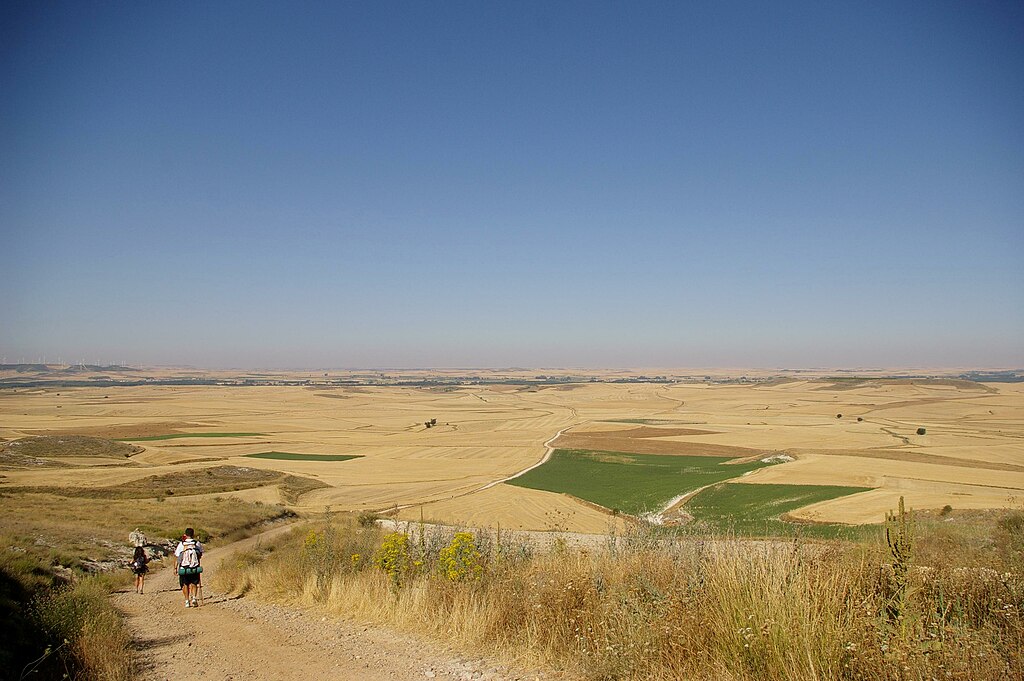
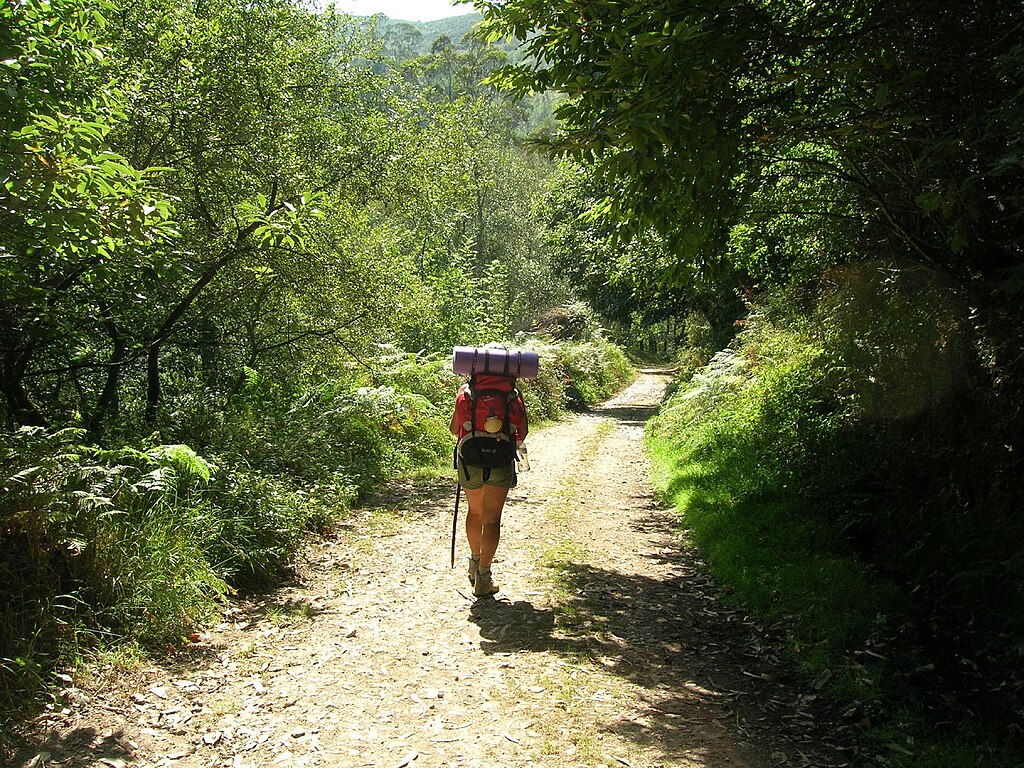


From top to bottom, left to right: (1) near Castrojeriz, Castile and León, Spain; (2) Camino Portugues, Galicia, Spain; (3) Burgos, Castile and Leon, Spain; (4) Camino Primitivo, Asturias, Spain; (5) Camino del Norte, near Ontón, Cantabria, Spain.
See Sources for full image details.

Cultural Heritage
The routes feature a breadth of cultural religious sites built around the pilgrimage – these include immovable cultural heritage such as cathedrals, churches, hospitals, hostels and bridges. Movable cultural heritage, such as religious reliquaries and archives, is also associated with the Camino. The UNESCO has listed 148 World Heritage Sites in Spain, and 71 in France.
Digital Interpretations
There are many digital interpretations of the cultural heritage sites along the routes. These may be a resource for pilgrims planning their journey and tourists visiting France or Spain.
The Agence Française des Chemins de Saint-Jacques de Compostelle has created an interactive map of the French UNESCO World Heritage sites, while the Spanish Federation of Associations of Friends of the St. James Way, with Google Arts and Culture, provides an online exhibition of 360 views from the UNESCO World Heritage Sites along the Spanish routes.
Digital interpretations can also be the opportunity to access heritage sites from home and see details which may otherwise difficult to access. This 3D reconstruction of the Tympanum of the Abbatiale Sainte-Foy in Conques, a UNESCO World Heritage Site on the French route departing from le Puy-en-Vellay, allows a closer look at a 9th century old stone work situated at 3,60m of height.
Image: Conques, by Jean-Pol GRANDMONT, 18 June 2004 (see sources for full details).
Intangible Cultural Heritage
Finally, the routes represent over twelve centuries of pilgrimage and religious practices. This is testified not only by an ongoing practice of the pilgrimage, but by symbols, objects and documents which represent pilgrimage practices. Two examples are the Scallop Shell and the Credentials, or Pilgrim Passport.
The Scallop Shell
The Scallop Shell is the symbol of the Apostle James the Greater and native to the coast of Galicia. In medieval times, the shell provided a memento for those pilgrims who reached Santiago, and it might even have had a practical use as measure for food and drinks.
Today, the Scallop Shell is an integral part of the Camino. It is used on road signs and embedded in the roads in cities along the Routes. On road signs, it is often shown alongside a yellow arrow to indicate the direction to Santiago de Compostela. Pilgrims may also wear the shell on their hats, walking sticks or bags, to indicate their participation in the centuries long practice of the pilgrimage.
Digital Interpretations
Watch a video about the Scallop Shell and the Camino:
Image right: Gomecha by Zarateman, 25 May 2018 (see sources for full details).

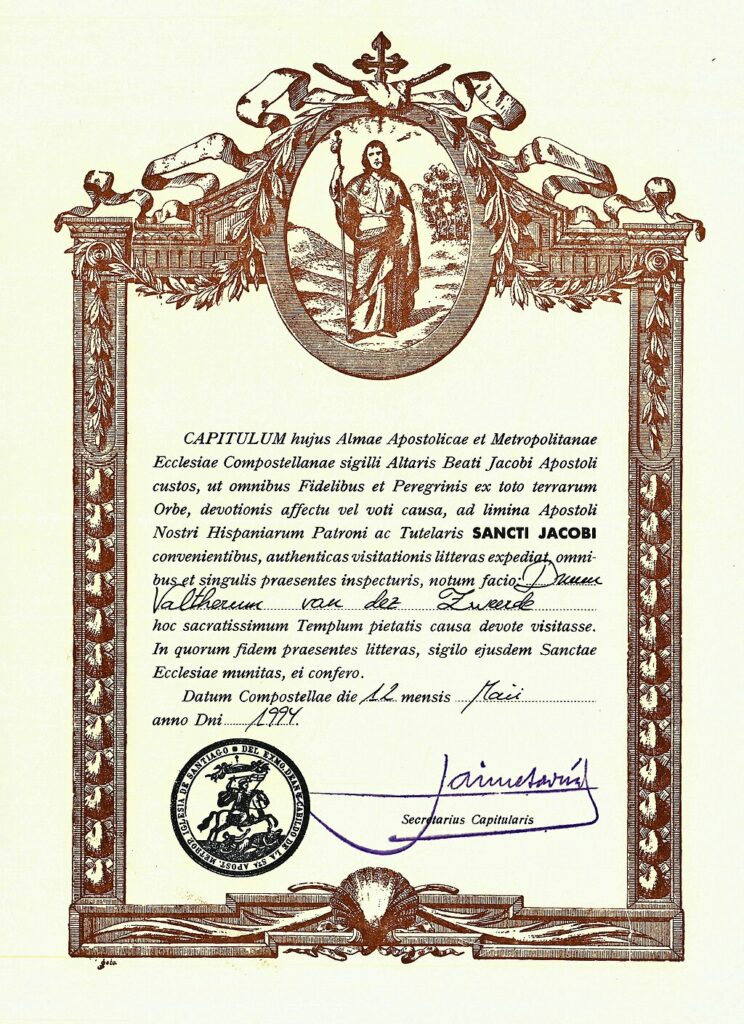
Credencial and Certificate
Since the middle-ages, pilgrims have had some forms of credentials to attest of their journey to Santiago de Compostela.
The Credencial is a sixteen-pages concertina-folded document which pilgrims can stamp at various locations along the Routes. It allows pilgrims to access hostels offered by Christian hospitality, and attest of their journey when they reach Santiago de Compostela. Pilgrims need to have completed the last 100km on foot to claim a certificate of completion of the pilgrimage at the Cathedral of Santiago de Compostela.
Credentials are available at the Cathedral and at the Oficina del Peregrino in Santiago de Compostela, as well as from various national associations for pilgrims, and at churches or hostels. A digital passport has recently been developed by the Oficino del Peregrino and is available on Android and iOS.
Image left: Compostela by PdO, 1 May 2019 (see sources for full details).
Image bottom: Pilgrim Passport by Jane023, 7 June 2007 (see sources for full details).

Sources:
UNESCO World Heritage Convention, ‘Routes of Santiago de Compostela: Camino Francés and Routes of Northern Spain’, UNESCO World Heritage Convention. Accessed: Feb. 15, 2024. [Online]. Available: https://whc.unesco.org/en/list/669/
UNESCO World Heritage Convention, ‘Routes of Santiago de Compostela in France’, UNESCO World Heritage Convention. Accessed: Feb. 15, 2024. [Online]. Available: https://whc.unesco.org/en/list/868
‘Camino de Santiago Routes’, CaminoWays.com. Accessed: Apr. 13, 2024. [Online]. Available: https://caminoways.com/camino-de-santiago-routes
S. Principal, ‘Conques – Le Tympan du Jugement dernier’. Accessed: May 05, 2024. [Online]. Available: http://www.tourisme-conques.fr/fr/conques/tympan
Maria, ‘The Scallop Shell and the Camino de Santiago’, CaminoWays.com. Accessed: Feb. 15, 2024. [Online]. Available: https://caminoways.com/the-scallop-shell-and-the-camino-de-santiago
‘Symbolism: The Use of Scallop Shells in Camino de Santiago magnificent Art and Architecture[6 FAQ’S] – Insider’s Travel’. Accessed: Apr. 13, 2024. [Online]. Available: https://insiderstravel.io/symbolism-camino-de-santiago-scallop-shell-art/
artsymbol, ‘The Scallop Shell was the emblem worn by pilgrims to Compostela’, COMPOSTELA: The Joining of Heaven & Earth. Accessed: Apr. 13, 2024. [Online]. Available: https://compostela.co.uk/symbols/scallop-shell/
‘The Credencial: Pilgrim’s Reception Office’. Accessed: Apr. 28, 2024. [Online]. Available: https://oficinadelperegrino.com/en/pilgrimage/the-credencial/
Roland, ‘What is the Camino Pilgrim Passport?’, CaminoWays.com. Accessed: Apr. 28, 2024. [Online]. Available: https://caminoways.com/camino-pilgrim-passport
Images:
Banner 1: Desde el Camino by Random username 083794703875938, 31 July 2012. Licence: Public Domain, via Wikimedia Commons. No Modification. URL: https://commons.wikimedia.org/wiki/File:Desde_el_Camino_imgn059.jpg

Banner 2: Camino del Norte by José Antonio Gil Martínez, 22 August 2009. Licence: CC BY 2.0 https://creativecommons.org/licenses/by/2.0, via Wikimedia Commons. No Modification. URL: https://commons.wikimedia.org/wiki/File:Camino_del_Norte_(4115035301).jpg
.jpg)
Banner 3: Coquille de Saint-Jacques de Pelerin by unknown, between 1000-1400, 8.5cm x 8.5cm x 2.5cm, Musee Carnavalet, Histoire de Paris. Licence: Public Domain via Wikimedia Commons. No Modification. URL: https://commons.wikimedia.org/wiki/File:Coquille_Saint-Jacques_de_p%C3%A9lerin,_AY992.jpg

Photography Gallery, from top to bottom, left to right:
(1) Camino near Castrojeriz, by MartinD, 6 August 2008. Licence: CC BY-SA 3.0 https://creativecommons.org/licenses/by-sa/3.0, via Wikimedia Commons. No Modification. URL: https://commons.wikimedia.org/wiki/File:Camino_near_Castrojeriz.jpg

(2) Bosque by José Antonio Gil Martínez, 10 September 2006. Licence CC BY 2.0 <https://creativecommons.org/licenses/by/2.0> via Wikimedia Commons. No Modification. URL: https://commons.wikimedia.org/wiki/File:Bosque_(248260791).jpg
.jpg)
(3) Por el Camino, by Random username 083794703875938, 31 July 2012. Licence: Public Domain via Wikimedia Commons. No Modification. URL: https://commons.wikimedia.org/wiki/File:Por_el_Camino_01_-_By_the_Way_01.jpg

(4) Camino Primitivao, by Simon Burchell, 22 August 2019. Licence: CC BY-SA 4.0 https://creativecommons.org/licenses/by-sa/4.0, via Wikimedia Commons. No Modification. URL: https://commons.wikimedia.org/wiki/File:Camino_Primitivo,_Embalse_de_Grandas_de_Salime_10.jpg

(5) Camino del Norte by José Antonio Gil Martínez, 22 August 2009. Licence: CC BY 2.0 https://creativecommons.org/licenses/by/2.0, via Wikimedia Commons. No Modification. URL: https://commons.wikimedia.org/wiki/File:Camino_del_Norte_(4115035301).jpg
Image 1: Conques, by Jean-Pol GRANDMONT, 18 June 2004. Licence CC BY 2.0 https://creativecommons.org/licenses/by/2.0, via Wikimedia Commons. No Modification. URL: https://commons.wikimedia.org/wiki/File:Conques_JPG02.jpg

Image 2: Gomecha by Zarateman, 25 May 2018. Licence: Public Domain via Wikimedia Commons. No Modification. URL: https://commons.wikimedia.org/wiki/File:Gomecha_46.jpg

Video: CaminoWays.com, ‘The Scallop shell and the Camino de Santiago’ youtube video, 12 September 2014. Last Accessed 28 April 2024. https://youtu.be/KNqXfbSRO-s?si=wEIFdZ3Tw6MqeZcD
Image 3: Compostela by PdO, 1 May 2019. Licence: CC BY-SA 4.0 https://creativecommons.org/licenses/by-sa/4.0, via Wikimedia Commons. No Modification. URL: https://commons.wikimedia.org/wiki/File:Compostela_1994.jpg

Image 4: Pilgrim Passport by Jane023, 7 June 2007. Licence: Public domain, via Wikimedia Commons. No Modification. URL: https://commons.wikimedia.org/wiki/File:Pilgrim_Passport1.jpg
