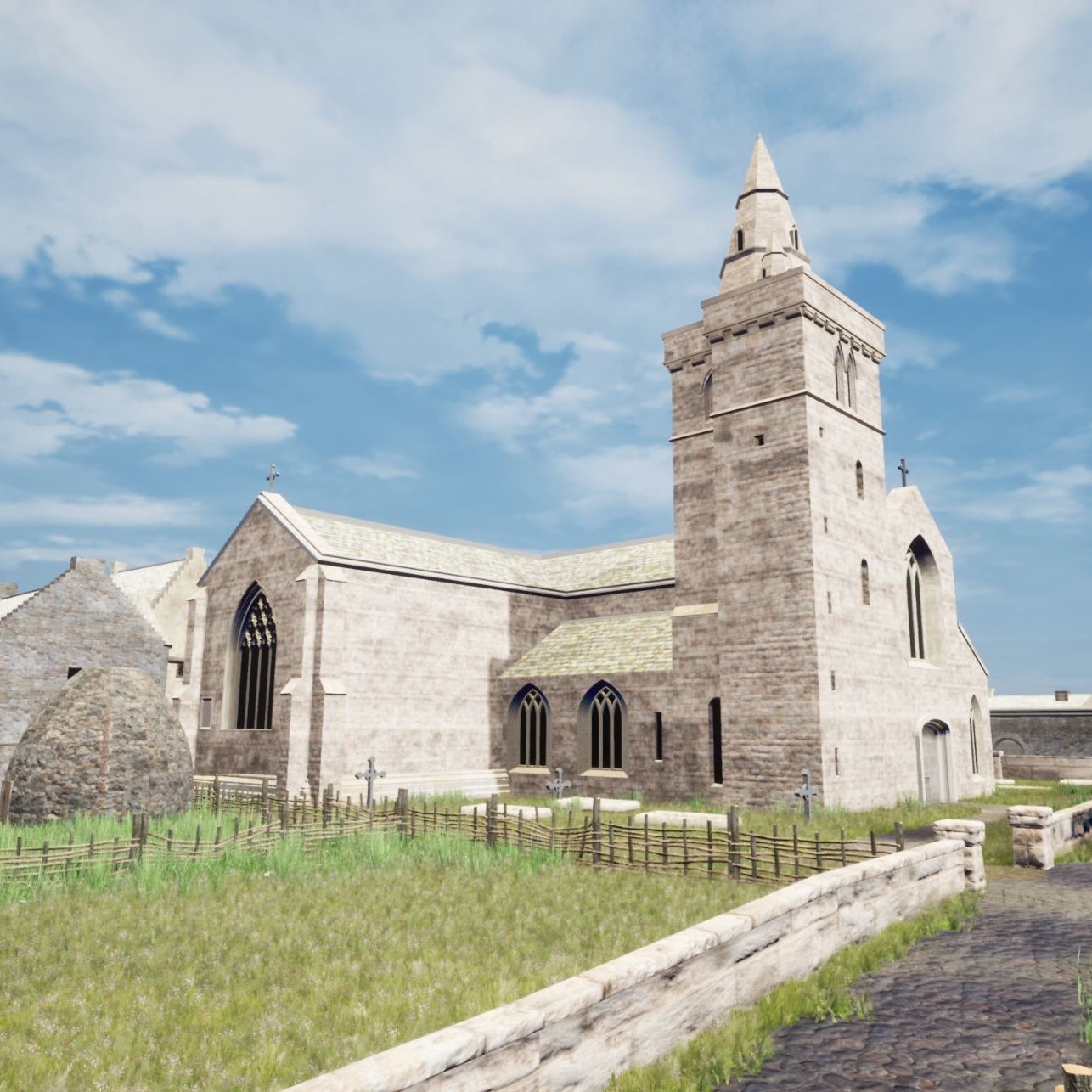
St Andrews Holy Trinity c1559
Dublin Core
Title
St Andrews Holy Trinity c1559
Description
Holy Trinity Church was for many years the main place of worship for St Andrews' ordinary residents. It was built in the early fifteenth century, near the residential and trading centre of St Andrews. During the late Middle Ages Holy Trinity was regarded as one of Scotland's leading parish churches and was served by about thirty priests. The interior was richly decorated with stained glass, luxurious fabrics, and statues imported from Flanders. In 1547 Holy Trinity was the scene of the first public sermon of the famous Reformer, John Knox. In 1559, Knox again preached in Holy Trinity, commanding the people of St Andrews to purge the city of "monuments of idolatry". Inspired by Knox's words, the local population rejected Catholicism, tore down statues and altars, and sacked St Andrews Cathedral. At the start of the twentieth century Holy Trinity was extensively remodelled. Today, only the tower and some pillars inside the church survive from the Middle Ages.
This project was funded by St Andrews Community Trust.
Source
reconstructions
Date
2019
Format
image/jpeg
Type
Reconstruction
Identifier
193
License
In Copyright (InC)
Spatial Coverage
current,56.3396,-2.7954;
Europeana
Is Shown At
https://www.openvirtualworlds.org/holy-trinity-church-1559/
Object
https://player.vimeo.com/video/348177059
Europeana Rights
Open Virtual Worlds Team University of St Andrews
Europeana Type
TEXT
Reconstruction Item Type Metadata
Canmore
http://canmore.org.uk/site/34347
How
Firstly, a digital landscape was created using survey data and height maps.
Following extensive historical research and collaboration with specialists, 3D models are created and imported into UNREAL Engine (a cross-platform game engine for creating virtual worlds). Models are textured, scaled, oriented and assembled. Scenes are created and populated with appropriate objects, including furniture and artefacts. Landscapes populated with flora and fauna. Weather settings and atmospheric lighting.
Where applicable, models of characters, animals or 3D digitised artefacts were imported and animated.
Evidence
Research regarding the historic architecture of Holy Trinity was undertaken by Dr Bess Rhodes and Perin Westerhof Nyman. Drawing upon historic maps and illustrations. We were able to better understand how the church may have been formed in 1559.
Advisers
Bess Rhodes (University of St Andrews), Peryn Westerhof Nyman (University of St Andrews), Chelsea Reutcke (University of St Andrews)
Date Represented
1559
Collection
Citation
“St Andrews Holy Trinity c1559,” STAGE, accessed October 17, 2026, https://stage.openvirtualworlds.org/omeka/items/show/134.
Embed
Copy the code below into your web page