Whithorn Hiberno-Scandinavian c1023
Dublin Core
Title
Whithorn Hiberno-Scandinavian c1023
Subject
Culture,Intangible Heritage
Description
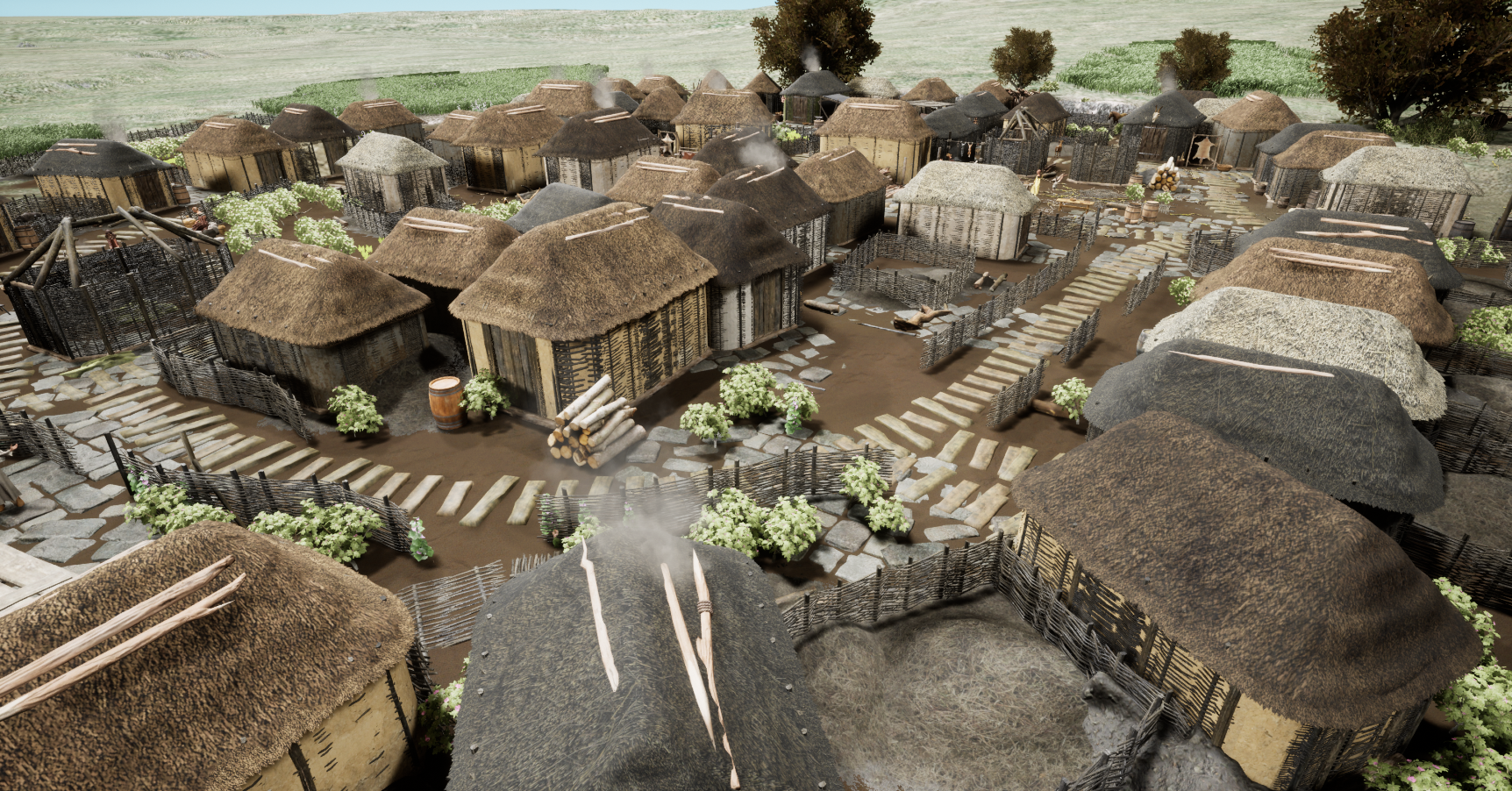
This reconstruction was a collaborative project between the Open Virtual Worlds Team at the University of St Andrews and the Whithorn Trust.
The Whithorn Trust is a charity (Registered no. SC012178 ) which was set up in 1986 to explore the archaeology and history of Whithorn, and to examine its role in the evolution of Christianity in Scotland.
The Trust was established as a direct consequence of an archaeological excavation at Whithorn in 1984. This project showed that remains had survived, which dated back to the early centuries of Whithorn’s development as a Christian centre. These discoveries were so significant as to justify further investigation.
The Trustees include individuals from the local community who have skills and interests relevant to the charity, including heritage, business and education. - Whithorn Trust
Date
2023/24
Format
image/png
Type
Reconstruction
Identifier
1531
License
In Copyright (InC)
Spatial Coverage
current,54.733467083763166,-4.420591592788697;
Europeana
Is Shown At
https://www.whithorn.com/
Object
https://player.vimeo.com/video/1105721437
Europeana Rights
Open Virtual Worlds Team University of St Andrews
Europeana Type
TEXT
Reconstruction Item Type Metadata
How
A digital landscape was created using survey data and height maps.
Following extensive historical research and collaboration with specialists, 3D models are created and imported into UNREAL Engine (a cross-platform game engine for creating virtual worlds). Models are textured, scaled, oriented and assembled. Scenes are created and populated with appropriate objects, including furniture and artefacts. Landscapes populated with flora and fauna. Weather settings and atmospheric lighting.
Clothing was researched and created for characters, who were then imported and animated.
Evidence
For 1023, the relevant Whithorn buildings are those ascribed to the early phases of Period IV.
The ‘classic’ Whithorn building is 4-5m wide by 5-6m long. There is a paved approach to the front door, and the paving continues over the door threshold as far as the central fireplace. The walls are of wattle and have two wattle walls about 20cm apart, with the intervening area stuffed with moss/straw/heather etc. – cavity wall insulation was a thing in the 11th century! On either side of the fireplace, low wattle walls support raised side-benches, similarly stuffed, which would have been used for both seating and sleeping.
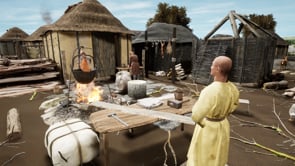
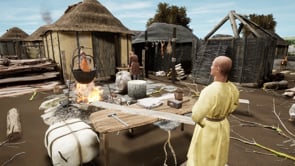
For 1023, there appears to be evidence for a fenced-off graveyard in part of the inner precinct, but evidence for antler and other craft-working immediately adjacent to it. This may have taken place in the open or under temporary shelters, as there were no structural remains associated with the craft debris. Craft activities in the buildings of the outer precinct include antler-working, leather working, blacksmithing, spinning, weaving and embroidery.
Advisers
Julia Muirwatt (Whithorn Trust)
Date Represented
1023
Citation
“Whithorn Hiberno-Scandinavian c1023,” STAGE, accessed October 16, 2026, https://stage.openvirtualworlds.org/omeka/items/show/4112.
Embed
Copy the code below into your web page